Library › Heart failure › Heart transplant candidacy and listing
Heart transplantation: candidacy, listing, donor selection, and immunology
Adult heart transplantation from referral and candidate evaluation through contraindications, sensitization and crossmatch, US allocation policy, donor selection and size matching, waitlist management, and outcomes.
Heart transplantation is the preferred therapy for eligible adults with stage D heart failure. Candidacy rests on two questions: whether the heart disease is severe and refractory enough to justify transplantation, and whether comorbidity, pulmonary vascular resistance, frailty, sensitization, and psychosocial factors allow an acceptable outcome. The 2024 International Society for Heart and Lung Transplantation (ISHLT) candidate guideline replaced fixed cutoffs with graded risk for most comorbidities. It recommends evaluation up to age 70, weight loss to a body mass index (BMI) below 35 kg/m², heart–kidney evaluation at an established glomerular filtration rate (GFR) below 30 mL/min/1.73 m², and at least 6 months of abstinence from tobacco, alcohol, and illicit drugs. US donor hearts are allocated first by a six-status urgency system, which ranks temporary mechanical support and life-threatening arrhythmia highest, and then by blood type and distance from the donor hospital.
Heart transplantation in advanced heart failure: benefit, volume, and the donor shortage
Heart transplantation gives longer survival and better quality of life than any other therapy for advanced heart failure. In 2024, a record 4,636 heart transplants were performed in the United States, 4,146 of them in adults (Colvin 2026). The number of adults awaiting transplantation has long exceeded the supply of donor hearts, so candidate selection and allocation decide who receives a scarce organ.
The 2022 AHA/ACC/HFSA heart failure guideline recommends transplantation in selected patients with advanced heart failure despite guideline-directed medical therapy (GDMT) to improve survival and quality of life (Class 1). The 2024 ISHLT guideline for cardiac transplant candidates replaced the 2006 candidate guideline and the 2016 listing criteria (Peled 2024; Mehra 2016). It moved from absolute contraindications toward individualized assessment and added guidance for older candidates, combined-organ transplantation, cancer survivors, sensitized candidates, and patients bridged with mechanical support.
Recognition of advanced heart failure and referral triggers are covered on the heart failure with reduced ejection fraction page, and durable left ventricular assist devices (LVADs) on the durable LVAD page.
Indications for heart transplantation
The common indications are highly symptomatic heart failure despite optimal medical and device therapy, cardiogenic shock that cannot be weaned from inotropes or temporary mechanical support, and uncontrollable ventricular arrhythmias. Less common indications are restrictive and infiltrative cardiomyopathy, hypertrophic cardiomyopathy with advanced heart failure, refractory angina in coronary disease that cannot be revascularized, complex congenital heart disease after failed palliation, and failure of a previous graft. Candidacy is considered only after reversible causes are treated and GDMT, cardiac resynchronization, and valve interventions such as transcatheter mitral repair are used where indicated.
The ISHLT clinical indicators of advanced heart failure are summarized by the I NEED HELP mnemonic: inotropes, persistent New York Heart Association (NYHA) class III or IV symptoms or high natriuretic peptides, end-organ dysfunction, a left ventricular ejection fraction (LVEF) below 20%, recurrent appropriate defibrillator shocks, more than one heart failure hospitalization in 12 months, persistent edema or escalating diuretics, systolic pressure consistently below 90 to 100 mm Hg, and inability to up-titrate GDMT. A preserved ejection fraction does not exclude advanced disease in restrictive or valvular cardiomyopathy, isolated right ventricular failure, or congenital disease.
| ISHLT 2024 recommendation for listing | Class | Level |
|---|---|---|
| Evaluation for advanced therapies, including transplantation, when clinical indicators of advanced heart failure are present and transplantation fits the patient's goals | 1 | B-NR |
| Cardiopulmonary exercise testing (CPET) in ambulatory adults referred for evaluation to quantify exercise intolerance, inform prognosis, and guide listing | 1 | B-NR |
| Right heart catheterization before listing to assess for prohibitive pulmonary hypertension and for shock requiring inotropes or temporary support | 1 | C-LD |
| Heart failure prognostic scores interpreted with other evaluation data | 2a | C-LD |
| Evaluation in advanced heart failure at age 70 years or younger | 1 | B-NR |
| Evaluation above age 70 years in carefully selected patients | 2b | B-NR |
| Care by a multidisciplinary team spanning heart failure cardiology, cardiac surgery, transplant coordination, infectious disease, pharmacy, immunology, mental health, social work, nutrition, rehabilitation, and palliative care | 1 | B-NR |
Indication and listing recommendations from the 2024 ISHLT guideline for cardiac transplant candidates (Peled 2024). B-NR, nonrandomized data; C-LD, limited data.
Disease-specific candidacy: amyloidosis, hypertrophic and restrictive cardiomyopathy, sarcoidosis, and congenital heart disease
Cardiac amyloidosis. Transplant evaluation is reasonable in light-chain (AL) or transthyretin (ATTR) cardiomyopathy with advanced heart failure (Class 2a). In AL amyloidosis, transplantation is not recommended (Class 3: Harm) with high-grade albuminuria, significant hepatic or gastrointestinal involvement, pulmonary amyloidosis with refractory effusions, neuropathy with autonomic dysfunction, or survival limited by the plasma cell disorder. In ATTR amyloidosis, transplantation is not recommended with gastrointestinal involvement and malnutrition, disabling autonomic neuropathy, or advanced age (Class 3: No Benefit). Transplant evaluation of highly symptomatic patients is not delayed to judge the response to tafamidis. Staging and therapy are covered on the cardiac amyloidosis page.
Hypertrophic cardiomyopathy. Evaluation is indicated in nonobstructive hypertrophic cardiomyopathy with NYHA class III or IV symptoms despite GDMT or with life-threatening ventricular arrhythmias refractory to therapy (Class 1). A reduced ejection fraction is not required, because restrictive physiology can cause advanced failure. Continuous-flow LVAD support is reasonable as a bridge when the left ventricular cavity is large enough, with better survival when the left ventricular end-diastolic diameter exceeds about 46 to 50 mm (Class 2a). Post-transplant survival is comparable to that with other diagnoses (hypertrophic cardiomyopathy page).
Restrictive cardiomyopathy, sarcoidosis, and connective tissue disease. In restrictive physiology, constrictive pericarditis is excluded before listing, because it is treated by pericardiectomy. In cardiac sarcoidosis, survival after transplantation is generally comparable to that of other recipients, and recurrence in the graft has been reported. Transplantation is not recommended when a connective tissue disease will shorten survival, causes severe noncardiac disease, or is uncontrolled (Class 3: No Benefit).
Adult congenital heart disease. Candidates are evaluated at centers with combined congenital and transplant expertise. Prior sternotomies, collaterals, anomalous anatomy, sensitization from transfusions and homografts, and Fontan-associated liver disease raise risk. In single-ventricle physiology, a peak oxygen consumption (VO₂) below 50% of predicted is often taken as support for listing. In US registry data, adults with congenital heart disease have among the lowest waitlist mortality of any diagnosis but the highest early mortality after transplantation. For recipients transplanted from 2017 to 2019, 1-year survival was 86.2% and 5-year survival 77.9% (Colvin 2026).
Exercise testing and prognostic scores in listing decisions
The historical peak VO₂ threshold comes from a 1991 cohort in which ambulatory patients with a peak VO₂ above 14 mL/kg/min had survival comparable to that after transplantation, so transplantation could be deferred (Mancini 1991). The 2024 ISHLT criteria adjust the threshold for beta-blockade, obesity, sex, age, and effort.
| Population | CPET finding that supports listing |
|---|---|
| Taking a beta-blocker | Peak VO₂ generally ≤12 mL/kg/min |
| Not taking a beta-blocker | Peak VO₂ generally ≤14 mL/kg/min |
| Obesity (BMI ≥30 kg/m²) | Peak VO₂ adjusted for lean body mass ≤19 mL/kg/min |
| All patients, especially with a submaximal test | VE/VCO₂ slope >35 |
| Women, or age ≤50 or ≥70 years | Peak VO₂ ≤50% of predicted |
CPET parameters supporting transplant listing, ISHLT 2024 Table 4. A maximal test is defined by a respiratory exchange ratio (RER) above 1.05 with the anaerobic threshold reached. No single value is the sole listing criterion.
A peak VO₂ measured at an RER below 1.05 reflects effort as well as cardiac reserve. The VE/VCO₂ slope does not require maximal effort, so it is the preferred marker after a submaximal test, and it discriminates better than peak VO₂ in women. CPET has no role in candidates sick enough for urgent inpatient evaluation. Repeat CPET while listed may be considered when symptoms or treatment change (Class 2b), and listing changes are not based on peak VO₂ alone (Class 3: No Benefit). Test conduct and interpretation are covered on the cardiopulmonary exercise testing page.
Prognostic scores. The Heart Failure Survival Score (HFSS) combines resting heart rate, mean arterial pressure, LVEF, serum sodium, peak VO₂, ischemic cause, and intraventricular conduction delay. One-year event-free survival in its derivation cohort was 93%, 72%, and 43% in the low-, medium-, and high-risk strata (Aaronson 1997), and the score kept its discrimination with beta-blockers (Koelling 2004). The Seattle Heart Failure Model estimates 1- to 3-year survival from clinical, laboratory, medication, and device variables (Levy 2006). MAGGIC and MECKI apply to ambulatory patients, and OPTIMIZE-HF, GWTG-HF, and ESCAPE to hospitalized patients. When listing is ambiguous, a score predicting 1-year survival below 85% may help guide the decision (Class 2a). Most scores predate contemporary GDMT and perform better in populations than in individuals, so none is the sole criterion.
Pulmonary vascular resistance and reversibility before transplantation
The donor right ventricle has not adapted to a high afterload, so recipient pulmonary vascular disease can cause acute graft right ventricular failure and early death. A pulmonary vascular resistance (PVR) of 2.5 Wood units or more is associated with higher early post-transplant mortality. Risk rises continuously with pulmonary artery systolic pressure (PASP), transpulmonary gradient (TPG), and PVR, and ISHLT states that no absolute cutoff exists.
A stepwise assessment is recommended in adults with a PASP of 50 mm Hg or more and either a TPG of 15 mm Hg or more or a PVR of 3 Wood units or more, with systolic arterial pressure kept above 85 mm Hg (Class 1). The steps are an acute vasodilator challenge (Class 1); hospitalization with continuous hemodynamic monitoring, because PVR often falls after 24 to 48 hours of diuretics, inotropes, and vasodilators (Class 1); and temporary or durable mechanical support to unload the left ventricle (Class 2a). An acceptable response lowers the TPG to 12 to 15 mm Hg or less and the PVR to 2.5 to 3 Wood units or less. A PVR that falls only with systolic pressure below 85 mm Hg leaves a high risk of right heart failure.
When medical therapy fails, pulmonary hypertension is reasonably judged irreversible only after unloading of the left ventricle with an intra-aortic balloon pump or an LVAD has also failed, and hemodynamics are reassessed 3 to 6 months after LVAD implantation (Class 2a). Heart transplantation alone is not recommended for severe pulmonary hypertension that does not reverse with these measures (Class 3: No Benefit). Heart–lung transplantation may be considered in carefully selected candidates (Class 2b), although its survival is lower than that of heart transplantation. Right heart catheterization is repeated periodically while listed (Class 1). The challenge itself is described on the right heart catheterization page and group 2 pulmonary hypertension on the pulmonary hypertension page.
Contraindications to heart transplantation in the 2024 ISHLT guideline
Extracardiac conditions are judged by whether they cancel the expected survival gain, impair rehabilitation and quality of life, or worsen under immunosuppression. The 2024 guideline treats most conditions as modifiable or relative and reserves Class 3 recommendations for a short list. Several thresholds are deferral points: a candidate who loses weight, controls diabetes, completes cancer treatment, or demonstrates abstinence can become eligible. ISHLT also recommends treating all patients with advanced heart failure as potential future candidates, with current vaccinations, cancer screening, and comorbidity control.
| Domain | Contraindication (transplantation not recommended) | Modifiable or relative barrier |
|---|---|---|
| Pulmonary vascular disease | Severe pulmonary hypertension not reversible with drugs and mechanical support (heart alone) | PASP ≥50 mm Hg with TPG ≥15 mm Hg or PVR ≥3 Wood units triggers reversibility testing |
| Age | None by age alone | Evaluation at 70 years or younger (1); above 70 in carefully selected patients (2b) |
| Obesity | None by BMI alone | Weight loss to BMI below 35 kg/m² before listing (2a) |
| Diabetes | None by diagnosis alone | End-organ damage or HbA1c above 7.5%: delay listing until control improves (2a) |
| Kidney | Heart alone generally not pursued at estimated GFR (eGFR) below 30 when kidney transplantation is not possible | Established GFR below 30: heart–kidney evaluation (1); GFR 30–44 with chronic kidney disease (2a) |
| Liver | Cirrhosis with portal hypertension (heart alone) | Heart–liver evaluation in biopsy-proven cirrhosis or severe fibrosis with portal hypertension (2a) |
| Cancer | Cancer with limited expected survival or high recurrence risk | Transplantation when cancer will not limit survival and recurrence risk is low (1); tumor-specific intervals |
| Infection | Active infection needing ongoing antibiotics, except an infected durable LVAD; uncontrolled HIV | Treated hepatitis C; monitored hepatitis B; latent tuberculosis treated while listed |
| Frailty | Severe frailty that will prevent rehabilitation and will not improve with restored cardiac function | Frailty assessment (2a); structured exercise and prehabilitation (1) |
| Substance use | Active tobacco smoking; excessive alcohol use | At least 6 months of abstinence from tobacco, alcohol, and illicit drugs (1) |
| Vascular, lung, and aortic disease | None as Class 3 | Severe uncorrectable cerebrovascular or peripheral disease, severe lung disease, porcelain aorta: benefit uncertain (2b) |
| Systemic disease | Uncontrolled or life-limiting connective tissue disease; AL amyloidosis with major extracardiac involvement | Sarcoidosis and controlled connective tissue disease after multidisciplinary review |
Contraindications and modifiable barriers to heart transplantation in adults, summarized from the 2024 ISHLT guideline (Peled 2024). Class of recommendation in parentheses. Program thresholds may be stricter.
Age and obesity in transplant candidates
Older recipients have more infection, kidney dysfunction, and malignancy after transplantation but less rejection. Mortality rises with age, most clearly above 70 years, although 5-year survival at 60 years or older is acceptable. For patients aged 70 or younger, eligibility rests on comorbidities without specific attention to age. Above 70, transplantation is considered in carefully selected patients with good function and controlled comorbidities, with tailored immunosuppression (Class 2b). Under the 2018 US allocation system, recipients aged 65 or older had lower 1-year survival than younger recipients (88.8% versus 92.3%), and donors aged 50 or older further lowered survival in these older recipients (Iyanna 2025). ISHLT lists program-specific age limits for dual-organ transplantation among the strategies for stewardship of scarce organs.
A BMI of 35 kg/m² or more lengthens the wait, because fewer donors are large enough, and increases waitlist and post-transplant mortality. Survival is best at normal weight and acceptable at a BMI of 30 to 35 kg/m². Weight loss to a BMI below 35 kg/m² before listing is reasonable (Class 2a), by lifestyle measures or, at some centers, bariatric surgery. A durable LVAD can bridge the patient to candidacy during weight loss.
Diabetes, vascular and lung disease, and surgical risk
About 30% of patients with advanced heart failure and 20% of recipients have diabetes. Uncomplicated diabetes does not worsen post-transplant survival, but diabetes with obesity, kidney dysfunction, or vascular disease does, and calcineurin inhibitors and corticosteroids worsen glycemic control. Delaying listing until control improves is reasonable when HbA1c exceeds 7.5% or end-organ damage is present (Class 2a), and a retinal examination helps gauge the duration and severity of diabetes (Class 2a).
Carotid ultrasound is recommended after stroke or with neurologic symptoms, and ankle–brachial indices with claudication, reduced pulses, atherosclerosis, or risk factors (Class 1 for both). The benefit of transplantation is uncertain with severe symptomatic cerebrovascular disease that cannot be revascularized, or with severe peripheral artery disease, especially nonhealing ischemic ulcers (Class 2b). Pulmonary function tests and chest CT are recommended after decongestion (Class 1), and severe parenchymal lung disease makes benefit uncertain (Class 2b). Prior cardiac surgery raises risk and is factored into eligibility (Class 1). A porcelain aorta prevents safe cross-clamping, and benefit is uncertain (Class 2b). Bone density is assessed, because corticosteroids and calcineurin inhibitors cause rapid bone loss (Class 1).
Kidney and liver dysfunction and combined-organ transplantation
Kidney evaluation. Kidney dysfunction in advanced heart failure reflects low output, venous congestion, and intrinsic disease. Evaluation separates injury that will recover after transplantation from chronic disease that will not. It reviews trends before decompensation, measures function after hemodynamic optimization, and identifies diseases such as diabetes or lupus that cause permanent injury (Class 1). GFR is estimated twice, at least 2 weeks apart, with race-free equations and confirmed by a measured GFR, such as a 24-hour creatinine clearance. Proteinuria, small or scarred kidneys, and nephrology review define intrinsic disease.
Heart–kidney transplantation. Evaluation for simultaneous heart–kidney transplantation is recommended at an established GFR below 30 mL/min/1.73 m² (Class 1). It is reasonable at 30 to 44 mL/min/1.73 m² with evidence of chronic kidney disease, such as small kidneys or proteinuria above 0.5 g/day (Class 2a). In a US registry analysis, combined transplantation improved survival at an eGFR below 37 mL/min/1.73 m², but the gain in median survival was small (7.7 versus 7.1 years). The benefit was largest with dialysis (median survival 12.6 versus 7.1 years) and absent without it. When eGFR is below 30 and kidney transplantation is not possible, heart transplantation alone is generally not pursued (Kittleson 2023).
Organ Procurement and Transplantation Network (OPTN) Policy 5.10.E sets medical eligibility for a kidney offered with a heart from the same donor. Adult candidates at status 1 to 5 within 500 nautical miles qualify when a transplant nephrologist confirms one of two conditions. The first is chronic kidney disease with a GFR of 60 mL/min or less for more than 90 days plus dialysis or a GFR of 30 mL/min or less. The second is sustained acute kidney injury with dialysis or a GFR of 25 mL/min or less at least weekly for 6 weeks. Under OPTN Policy 8.4.G, a heart recipient registered for a kidney before the first transplant anniversary receives kidney priority. Qualification requires dialysis, or a measured or estimated GFR or creatinine clearance of 20 mL/min or less, documented between day 60 and day 365 after the heart transplant.
Liver evaluation. Liver tests, the MELD-XI score (Model for End-Stage Liver Disease excluding the international normalized ratio), and abdominal imaging are recommended (Class 1). Congestive hepatopathy may reverse after transplantation, whereas cirrhosis does not, and imaging cannot reliably distinguish the two. Transvenous liver biopsy gives histology and the hepatic venous pressure gradient, and a gradient of 5 mm Hg or less excludes significant portal hypertension. Short-term mortality after isolated heart transplantation in cirrhosis is as high as 50%. Heart–liver evaluation is reasonable in biopsy-proven cirrhosis or severe fibrosis with portal hypertension (Class 2a). In recent registry data, heart–liver and heart–kidney recipients have survival comparable to heart-alone recipients (Colvin 2025).
Prior malignancy and cancer screening in candidates
Pre-transplant malignancy predicts post-transplant cancer and lower survival, particularly when hematologic, high risk, or diagnosed within 1 year of transplantation. Candidates undergo age-appropriate screening under general population guidelines, and dermatologic examination is useful (Class 2a). Routine positron emission tomography (PET) screening for occult cancer is not recommended. With prior cancer, risk is stratified with oncology (Class 1), and transplantation is recommended when cancer-related survival will not limit post-transplant survival and recurrence risk is low (Class 1). Fixed intervals applied without regard to tumor biology delay listing without benefit.
| Prior cancer | Suggested interval after treatment |
|---|---|
| Breast: in situ or stage I / stage II / stage III / stage IV | No wait / 1–2 years / 3–5 years / not eligible |
| Colon: stage I / stage II (T3) / stage III | 1 / 2 / 3 years (5 with high-risk features) |
| Prostate: low risk (prostate-specific antigen below 10 ng/mL, Gleason 6, T1c–T2a) | No wait |
| Renal cell: T1a (≤4 cm), N0, M0 | No wait |
| Lung: stage I (T1a–T1b, N0) / stage IIIB or higher | ≥3 years / not eligible |
| Melanoma: in situ / stage IA–IIA / stage IIIC–IV | No wait / 1 year / ≥5 years |
| Diffuse large B-cell, follicular, or Hodgkin lymphoma | 2 years |
| Myeloma | Stringent complete response, marrow plasma cells below 1%, no high-risk cytogenetics, remission longer than 6 months |
Selected pre-transplant intervals for prior cancer, from ISHLT 2024 Tables 5–8, adapted from American Society of Transplantation and International Transplant Skin Cancer Collaborative consensus statements. Decisions are individualized with oncology.
Infection screening, HIV, hepatitis, and vaccination
Candidates are screened for infections that can reactivate under immunosuppression (Class 1): HIV RNA and CD4 count; hepatitis B surface antigen, core antibody, and surface antibody; hepatitis C antibody and nucleic acid; latent tuberculosis; Trypanosoma cruzi serology in candidates from Latin America; and cytomegalovirus, Epstein–Barr virus, toxoplasma, syphilis, and regional pathogens. Latent tuberculosis is treated for 6 to 9 months without delaying transplantation, and chronic hepatitis C is treated with direct-acting antivirals.
Active infection requiring ongoing antibiotics defers transplantation (Class 3: No Benefit), except infection of a durable LVAD, which removal of the device at transplantation often cures. Selected patients with HIV are transplanted successfully. Transplantation is not recommended with opportunistic infection or HIV-related malignancy, an unstable antiretroviral regimen, detectable HIV RNA, or a CD4 count below 200 cells/µL in the preceding 3 months. Vaccination is ideally completed at least 2 weeks before transplantation (Class 1), and transplantation is deferred 4 weeks after a live-attenuated vaccine. ISHLT notes that refusal of recommended vaccination may be considered a contraindication.
Frailty and nutrition in transplant candidates
Frailty occurs in up to 50% of patients with heart failure and predicts death on the list and after transplantation. The frailty phenotype scores exhaustion, weakness, slowness, low activity, and weight loss. Modified versions replace weight loss with loss of appetite, because fluid retention masks weight loss, and replace grip strength with five chair rises, scored as frail when they take more than 15 seconds. Frailty from low output and congestion can reverse after LVAD implantation or transplantation, whereas frailty from age, sarcopenia, and neurologic disease does not.
Frailty assessment is useful to stratify risk and target conditioning (Class 2a), and regular structured exercise is recommended (Class 1). Transplantation is not recommended in severe frailty that will prevent rehabilitation and will not improve with restored cardiac function (Class 3: No Benefit). Nutrition is assessed at evaluation and while listed (Class 1). The ISHLT frailty framework is covered on the durable LVAD page (Denfeld 2024).
Psychosocial evaluation, substance use, and caregiver support
Transplantation requires lifelong adherence to immunosuppression, frequent visits, and surveillance testing. The psychosocial evaluation, by psychiatrists, psychologists, or social workers, assesses substance use, social support, adherence, mental health, and cognition (Dew 2018).
At least 6 months of abstinence is recommended before listing for illicit drug use, alcohol use disorder, and tobacco smoking (Class 1 for all three). Abstinence is confirmed by drug screens, phosphatidylethanol for alcohol, and cotinine for nicotine. Active smoking is a contraindication because it increases malignancy, allograft vasculopathy, kidney dysfunction, and death after transplantation, and ISHLT advises avoiding all nicotine products, including e-cigarettes. Abstinence from cannabis before listing is reasonable (Class 2a), because inhaled cannabis raises the risk of fungal lung infection and cannabinoids interact with azoles, calcineurin inhibitors, warfarin, and statins.
Confirmation of committed caregivers who understand the illness and their role is recommended (Class 1), as are demonstrated adherence and control of mental illness (Class 1). Structured instruments are useful (Class 2a). The Stanford Integrated Psychosocial Assessment for Transplantation (SIPAT) classifies scores of 0 to 6 as excellent, 7 to 20 as good, 21 to 39 as minimally acceptable, and 40 to 68 as high risk. The Psychosocial Assessment of Candidates for Transplantation (PACT) and the Transplant Evaluation Rating Scale (TERS) are alternatives. LVAD-specific caregiver requirements are covered on the durable LVAD page.
HLA sensitization, panel reactive antibody, and calculated PRA
Sensitization is the presence of preformed antibodies against human leukocyte antigens (HLA). It results from exposure through pregnancy, transfusion (platelets carry the most HLA), prior transplantation, homografts, mechanical circulatory support, and dialysis. Infection can boost it by cross-reactivity. Sensitized candidates wait longer and have more antibody-mediated rejection, allograft vasculopathy, and death after transplantation (Kobashigawa 2018). Women sensitized by pregnancy, retransplant candidates, adults with congenital heart disease, and patients on mechanical support are overrepresented.
The historical panel reactive antibody (PRA) test reported the percentage of a lymphocyte panel that the candidate's serum killed. Solid-phase single-antigen bead assays now identify individual HLA antibodies and report their strength as mean fluorescence intensity (MFI). The program lists as unacceptable the donor HLA antigens against which the candidate has significant antibodies. The calculated PRA (cPRA) is the percentage of donors in a reference population who carry at least one of those antigens and are therefore incompatible with the candidate (Chang 2012). OPTN requires reporting of cPRA, peak PRA, and the number of prior sternotomies at registration. ISHLT defines a PRA above 10% or donor-specific antibodies at transplantation as risk factors for a suboptimal outcome.
HLA antibody screening is recommended at 3- to 6-month intervals while listed (Class 1) and about 3 weeks after a sensitizing event, because de novo antibodies peak at about 21 days (Class 1). In previously sensitized candidates, screening as early as 7 days can be considered, because memory responses appear within 5 to 7 days (Class 2a). Exposure is minimized with leukoreduced products, single-donor or HLA-matched platelets, and decellularized homografts (Class 2a).
Crossmatch strategies: virtual, prospective, and retrospective
A crossmatch tests whether the recipient has antibodies against a specific donor. The complement-dependent cytotoxicity crossmatch detects antibodies that kill donor lymphocytes with complement, and a positive T-cell result predicts hyperacute rejection. The flow cytometry crossmatch detects recipient IgG bound to donor T and B cells and is more sensitive. A physical crossmatch requires donor cells and takes hours. Because the target ischemic time is 4 hours or less, hearts are not allocated by HLA matching, and a prospective physical crossmatch is feasible only for nearby donors.
The virtual crossmatch compares the candidate's antibody profile with the donor's HLA type. If the donor carries none of the unacceptable antigens, the offer can be accepted without a prospective crossmatch, which is then performed retrospectively. In sensitized candidates, a virtual crossmatch predicted the antihuman globulin-enhanced cytotoxicity crossmatch with a positive predictive value of 79% and a negative predictive value of 92%. Patients transplanted on a compatible virtual crossmatch alone had rejection and survival similar to those transplanted after a prospective crossmatch (Stehlik 2009). Preformed antibodies are compared against donor HLA, at least virtually, before acceptance (Class 2a) (Copeland 2023).
No agreed standard defines which donor-specific antibodies may be crossed. Programs weigh MFI, complement binding on a C1q assay, urgency, and program experience, and monitor a recipient who crosses an antibody closely for antibody-mediated rejection. Organ consideration in sensitized patients follows a plan made in advance with the histocompatibility laboratory (Class 1).
Desensitization of highly sensitized candidates
Desensitization lowers HLA antibodies to enlarge the compatible donor pool, and ISHLT considers it reasonable at a cPRA above 50% (Class 2a). Regimens combine plasmapheresis, high-dose intravenous immunoglobulin, rituximab for B-cell depletion, and bortezomib for plasma cell inhibition. Responses are variable and often partial, so success is judged by whether the cPRA falls enough to permit a compatible offer. Prospective trials are lacking (Kobashigawa 2018). Imlifidase, an IgG-cleaving enzyme from Streptococcus pyogenes, has conditional European approval for highly sensitized kidney candidates but is not approved in the United States; its use in heart transplantation is limited to case reports (Lázár-Molnár 2025). Induction therapy can be considered in sensitized recipients (Class 2a). Other strategies are acceptance of older or extended-criteria donors with a negative crossmatch, and durable LVAD support when the expected wait is long.
US adult heart allocation: the six-status system
Before October 18, 2018, US adults were ranked in three tiers. Status 1A covered the most urgent candidates, such as those on temporary mechanical support, mechanical ventilation, or high-dose or multiple inotropes with hemodynamic monitoring, and also allowed time-limited listing for stable LVAD support. Status 1B covered other candidates with a ventricular assist device or continuous inotropes, and status 2 included all others. The tiers poorly separated stable outpatients with durable LVADs from patients in shock (Shore 2020). The 2018 policy created six adult statuses ranked by urgency and broadened geographic sharing. A candidate defaults to status 6, or status 5 if registered for another organ, when no justification form is submitted or a status expires.
| Adult status | Qualifying criteria (OPTN Policy 6.1) | Initial duration |
|---|---|---|
| 1 | VA-ECMO for cardiogenic shock; nondischargeable surgically implanted biventricular support; mechanical support with recurrent VT or VF requiring cardioversion despite intravenous antiarrhythmics | 7 days |
| 2 | Nondischargeable surgical LVAD; total artificial heart, RVAD, BiVAD, or VAD for single ventricle; device malfunction requiring replacement; percutaneous endovascular support or IABP for cardiogenic shock; recurrent VT or VF not amenable to ablation; dischargeable LVAD for 8 years or more | 14 days (180 for LVAD ≥8 years) |
| 3 | Dischargeable LVAD, 30 discretionary days; high-dose or multiple inotropes with hemodynamic monitoring in cardiogenic shock; mechanical support with hemolysis, pump thrombosis, right heart failure, device infection, mucosal bleeding, or aortic insufficiency; VA-ECMO after 7 days; nondischargeable LVAD, percutaneous device, or IABP after 14 days; dischargeable LVAD for 6 years or more | 7 to 180 days by criterion |
| 4 | Dischargeable LVAD without discretionary time; inotropes without continuous monitoring (cardiac index below 2.2 L/min/m², wedge above 15 mm Hg); hemodynamically significant congenital heart disease; refractory CCS class IV angina; amyloidosis, hypertrophic, or restrictive cardiomyopathy with severe symptoms or arrhythmia; retransplant with CAV grade 2–3 or NYHA III–IV | 90 days (180 for inotropes) |
| 5 | Registered at the same hospital for heart and at least one other organ | 180 days |
| 6 | All other adult candidates suitable for transplantation | 180 days |
US adult heart allocation statuses, OPTN Policy 6.1. VA-ECMO, venoarterial extracorporeal membrane oxygenation; IABP, intra-aortic balloon pump; VT, ventricular tachycardia; VF, ventricular fibrillation; CCS, Canadian Cardiovascular Society; CAV, cardiac allograft vasculopathy; RVAD, right ventricular assist device; BiVAD, biventricular assist device.
Hemodynamic definitions. For VA-ECMO at status 1, shock is documented within 7 days before support by systolic pressure below 90 mm Hg, cardiac index below 1.8 L/min/m² without inotropes or below 2.0 L/min/m² with them, and wedge pressure above 15 mm Hg, all within one 24-hour period. Without hemodynamics, any one of the following within 24 hours before support qualifies: cardiopulmonary resuscitation, systolic pressure below 70 mm Hg, arterial lactate above 4 mmol/L, or aminotransferase above 1,000 U/L. For an intra-aortic balloon pump or a percutaneous ventricular assist device at status 2, shock requires systolic pressure below 90 mm Hg, cardiac index below 2.0 L/min/m², and wedge pressure above 15 mm Hg. It also requires qualifying inotropes (for example, dobutamine 7.5 µg/kg/min, milrinone 0.50 µg/kg/min, or epinephrine 0.02 µg/kg/min, or two lower-dose agents) or ventricular tachycardia lasting at least 30 seconds or requiring cardioversion, defibrillation, or antitachycardia pacing during inotrope titration. The same alternative criteria apply when hemodynamics could not be obtained. VA-ECMO, a nondischargeable surgical LVAD, a percutaneous device, or an IABP stays at status 1 or 2 beyond the initial 7 or 14 days only with regional review board approval. Approval requires a contraindication to durable support and a failed weaning attempt within 48 hours before the status expires, shown by mean arterial pressure below 60 mm Hg, cardiac index below 2.0 L/min/m², wedge pressure above 15 mm Hg, or central venous saturation below 50%. For an IABP or percutaneous device, the weaning attempt is made on qualifying inotropes unless the candidate originally qualified through ventricular tachycardia. Without an extension, the candidate moves to status 3.
Waiting time and exceptions. Waiting time accrues within a status. Time at a lower status does not carry up; time at a higher status carries down. When urgency is not captured by the criteria, the physician may request an exception at status 1 to 4, reviewed retrospectively by a regional review board for 14-day periods (90 days at status 4). A US Food and Drug Administration device recall that cannot be mitigated without replacement is a specific ground. Extensions vary widely by region, from 0% to 30.2% of status 1 candidates, and many candidates stay at their status beyond the intended limits (Endo 2025). ISHLT recommends reassessing urgency regularly and at any clinical change (Class 1) and does not support upgrades for decompensation that resolves with adjustment of oral therapy, arrhythmia treatment, or device optimization (Class 3: No Benefit).
Temporary and durable mechanical support in the listing strategy
Because temporary support defines statuses 1 and 2, more patients are now transplanted from temporary devices without an intervening durable LVAD. In 2024, 54.9% of US adult transplants were performed at status 2, and 974 recipients were transplanted on a microaxial pump alone, 716 on an IABP alone, and 189 on ECMO alone (Colvin 2026). Candidates on temporary support are assessed within days, because complications rise with duration, and neurologic integrity is confirmed in sedated patients. Kidney, liver, and respiratory failure predict early death. In registry analyses, ECMO and percutaneous temporary LVADs predicted post-transplant mortality, and 1-year survival after temporary-support bridging has ranged from 50% to 90%. Device management is covered on the temporary mechanical circulatory support page and the cardiogenic shock page.
Stable patients with a dischargeable LVAD are listed at status 4, apart from 30 discretionary days at status 3. Complications raise them to status 3 and malfunction requiring replacement to status 2. Continuous support by a qualifying dischargeable LVAD for 6 or more years qualifies for status 3, and for 8 or more years for status 2, both for renewable 180-day periods. Durable support remains the strategy when the expected wait is long, as for blood type O, large body size, or high sensitization, and when pulmonary hypertension or kidney function must improve first (durable LVAD page; LVAD complications page).
Geographic distribution and blood type priority
Within a classification of OPTN Policy 6.6, candidates are ranked by waiting time at their status. Classifications combine status, blood type, and distance between donor and transplant hospitals. Blood type O donor hearts go first to type O or B candidates and then to type A or AB candidates; type A, B, and AB hearts go to ABO-identical or type AB recipients. Intended ABO-incompatible offers are limited to pediatric candidates.
| Sequence for hearts from donors 18 years or older | Distance from donor hospital |
|---|---|
| Adult status 1, then status 2 | 500 nautical miles |
| Adult status 3 | 250 nautical miles |
| Adult status 1, then status 2 | 1,000 nautical miles |
| Adult status 4 | 250 nautical miles |
| Adult status 3 | 500 nautical miles |
| Adult status 5 | 250 nautical miles |
| Adult status 3 | 1,000 nautical miles |
| Adult status 6 | 250 nautical miles |
| Adult statuses 1, 2, and 3, then statuses 4, 5, and 6 | 1,500, then 500 nautical miles; wider circles follow |
Simplified allocation sequence for adult donor hearts, OPTN Policy 6.6.D. Rows are offered to primary before secondary blood type matches; pediatric status 1A shares rows with adult status 1, and pediatric 1B with adult status 3.
This design sends hearts farther to the most urgent candidates, which lengthens ischemic time. Allocation in Europe differs: France ranks candidates by a continuous national risk score, and Spain and Eurotransplant give high-urgency priority to short-term mechanical support, with time limits for ECMO in some systems.
Outcomes after the 2018 allocation change
In a comparison of 14,908 candidates listed after the change with seasonally matched earlier candidates, the 1-year incidence of transplantation roughly doubled (subhazard ratio 2.06), delisting for death or deterioration fell (subhazard ratio 0.58), and 1-year survival from listing rose from 86.8% to 90.0%. Four-year post-transplant survival was unchanged at 83.3% versus 82.8% (Hong 2025). The trade-offs were older donors, longer ischemic times, greater reliance on temporary support, and growing use of status extensions (Endo 2025). Candidates at statuses 1 and 2 are transplanted much faster than others, and adult waitlist mortality, 14.9 deaths per 100 patient-years in 2013, has been stable at 8.4 to 8.7 since 2019 (Colvin 2026). Later OPTN amendments revised status 2 device requirements and added escalation for long-duration LVAD support.
Donor selection: age, function, hypertrophy, coronary disease, and ischemic time
Donor acceptance is judged against the intended recipient. A heart unsuitable for a stable status 6 candidate may be lifesaving for a candidate on ECMO or a highly sensitized candidate, and extended-criteria donors are considered for such recipients (Class 2a). Most ISHLT donor recommendations are Level of Evidence C (Copeland 2023).
| Donor factor | ISHLT donor heart selection guidance |
|---|---|
| Age | Donors younger than 45 recommended (1). Donors 45 or older used after coronary screening and with expected ischemic time under 4 hours (1); no upper age limit. Older donors suit older or highly sensitized recipients with a negative crossmatch (2a). |
| Ischemic time | Target total ischemic time 4 hours or less (1); longer acceptable for donors under 45 (2a). Ex vivo normothermic perfusion can shorten ischemic time for distant procurement (2a). |
| LV function | Echocardiography required (1); serial studies identify reversible dysfunction after brain death (1). Hearts from young donors with an initially low LVEF are pursued with repeat imaging (2a). Stress echocardiography and strain separate stunning from disease (2a). |
| Hypertrophy | Septal thickness: mild 11–13 mm, moderate 14–16 mm, severe ≥17 mm. Selected hearts above 13 mm may be used, particularly from donors 40 or younger with short ischemic time (2a). |
| Coronary disease | Angiography or CT angiography in donors older than 45 or with diabetes, smoking, or cocaine or amphetamine use (2b). Irregularities up to 50% acceptable (2a); left main or 2- to 3-vessel obstructive disease avoided (2b). |
| Donor management | Pulmonary artery catheter and goal-directed therapy when vasopressors are needed (2a): mean arterial pressure above 60 mm Hg, cardiac index above 2.4 L/min/m², central venous and wedge pressure below 12 mm Hg. Low-dose norepinephrine alone is compatible with use (1). |
| Metabolic and toxic | Donor sodium below 129 mEq/L or at or above 170 mEq/L excludes use (2a). Carbon monoxide poisoning with carboxyhemoglobin above 40%, troponin I ≥0.7 ng/mL, an ischemic ECG, or ventricular dysfunction generally excludes use (3). Cocaine use is acceptable without hypertrophy of 14 mm or more (2a). |
| Cardiac arrest | Cardiopulmonary resuscitation longer than 30 minutes does not reduce survival when LVEF exceeds 50% after resuscitation (2a). |
| Infection | Bacteremic donors usable with targeted recipient treatment (2a). Hepatitis B core antibody–positive donors usable with prophylaxis (2a). Disseminated aspergillosis and active coccidioidomycosis or histoplasmosis exclude use (3). |
Selected recommendations from the ISHLT donor heart selection guideline (Copeland 2023), class in parentheses. Natriuretic peptides alone are not reasons to decline a donor; markedly raised troponin prompts coronary angiography.
Donor–recipient size and sex matching
Weight was the traditional size metric, and donors under 70% of recipient weight were avoided. Weight correlates poorly with heart size, however, and women have smaller hearts than men of the same height and weight. Predicted heart mass (PHM) sums predicted left and right ventricular mass from MRI-derived equations in the Multi-Ethnic Study of Atherosclerosis, using sex, age, height, and weight. In 31,634 US pairs, the most undersized PHM septile had higher first-year mortality (adjusted hazard ratio 1.25), weight mismatch did not predict survival, and the excess risk of sex mismatch was explained by heart mass (Reed 2014). In 19,168 recipients, a donor-to-recipient PHM ratio of 0.54 to 0.86 carried higher 1-year mortality (hazard ratio 1.34), and 32% of offers declined for size would have been acceptable at a ratio of 0.86 or more (Kransdorf 2019).
The 2024 ISHLT guideline considers height, weight, sex, and PHM useful for matching (Class 2a). The donor guideline considers a PHM within 20% to 30% of the recipient acceptable and allows female donors for male recipients with adequate PHM, especially without pulmonary hypertension (Class 1). Undersized grafts carry the most risk in recipients with pulmonary hypertension. Oversizing for moderate pulmonary hypertension (PVR 2.5 to 5.0 Wood units or TPG 10 to 18 mm Hg) gave no survival benefit at 90 days or 1 year.
Predicted heart mass calculator
Predicted left ventricular mass (g) = a × height (m)0.54 × weight (kg)0.61, with a = 6.82 for women and 8.25 for men. Predicted right ventricular mass (g) = a × age−0.32 × height (m)1.135 × weight (kg)0.315, with a = 10.59 for women and 11.25 for men. A 30-year-old woman (163 cm, 60 kg) has a predicted heart mass of about 130 g and a 55-year-old man (180 cm, 90 kg) about 201 g, a ratio of 0.65 in the undersized range.
Expanded donor pools: circulatory death, hepatitis C–viremic, and increased-risk donors
Donation after circulatory death (DCD). After withdrawal of life support and declaration of death, the heart is recovered by direct procurement with ex vivo normothermic perfusion or by normothermic regional perfusion in the donor. In a US randomized noninferiority trial of 180 transplant recipients, risk-adjusted 6-month survival in the as-treated population was 94% with DCD hearts assessed on ex vivo perfusion and 90% with brain-dead donor hearts in cold storage (P<0.001 for noninferiority) (Schroder 2023). DCD hearts supplied 17.9% of US donor hearts in 2024 (Colvin 2026).
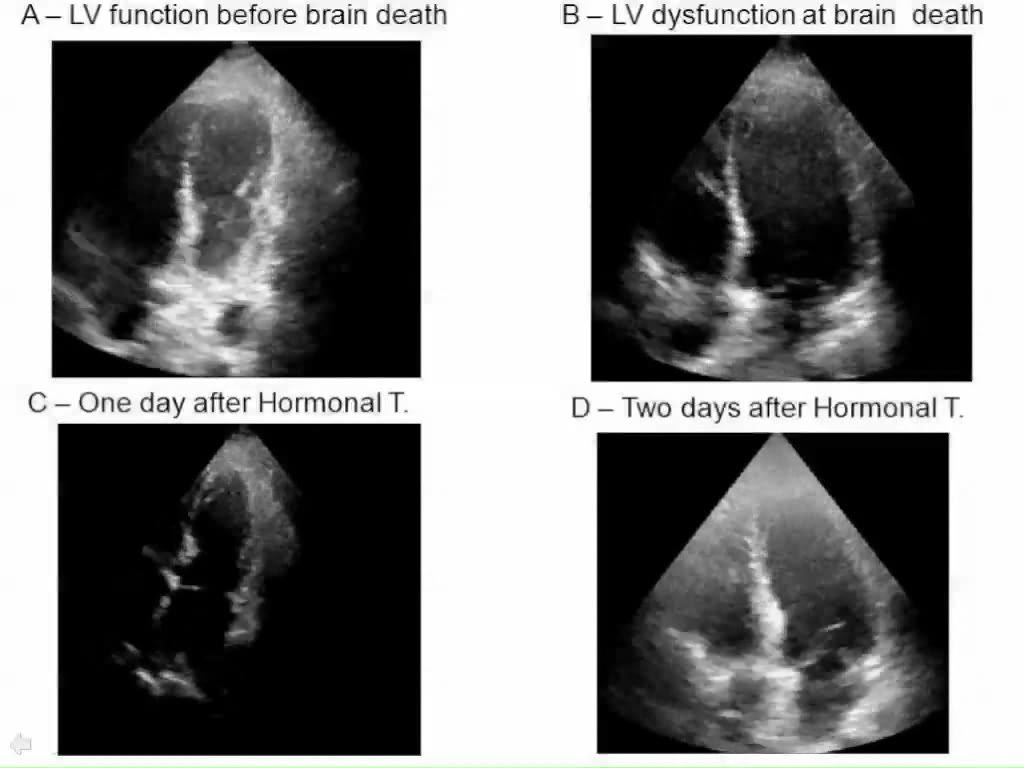
Serial apical four-chamber views of a potential heart donor. A, normal function before brain death. B, takotsubo-like dysfunction after subarachnoid hemorrhage and brain death, which excludes the heart by standard criteria. C, improvement 1 day after hormonal treatment with triiodothyronine, vasopressin, insulin, and methylprednisolone. D, normal function at 2 days; the heart was transplanted successfully. Still frame from a video by Casartelli M, Bombardini T, Simion D, Gaspari M, Procaccio F (Wikimedia Commons, from Cardiovasc Ultrasound 2012;10:25), CC BY 2.0; frame extracted from the original video.
Hepatitis C–viremic donors. In a trial of 44 heart and lung recipients of hepatitis C virus (HCV)–viremic organs given sofosbuvir–velpatasvir for 4 weeks starting within hours of transplantation, all 35 with 6 months of follow-up were alive with good graft function and undetectable virus (Woolley 2019). In US registry data, such heart transplants rose from 1 in 2015 to 181 in 2021, with survival and complications similar to those from uninfected donors through 3 years (Ruck 2022). ISHLT considers HCV-viremic donors acceptable for HCV-negative recipients with an antiviral plan in place before transplantation (Class 2a).
Increased-risk donors. US criteria identify behavioral and medical factors in the 30 days before death, such as injection drug use, sex in exchange for money or drugs, and incarceration for 72 hours or more, that raise the risk of an undetected recent HIV, hepatitis B, or hepatitis C infection. Carefully selected donors with these factors may be used with consent and post-transplant surveillance (Class 1, Level B). Toxicology positive for amphetamines or multiple substances does not exclude a structurally and functionally normal heart (Class 2a).
Waitlist management: medical therapy, devices, surveillance, and delisting
Maximally tolerated GDMT is continued in listed patients with reduced ejection fraction (Class 1). Continuous inotropes, started after pulmonary artery catheter profiling, can be used for shock, low output, or organ dysfunction (Class 2a). Long-term inotropes as an alternative to durable support may be considered (Class 2b), and routine midodrine or droxidopa to avoid inotropes is not recommended (Class 3: No Benefit). Intermittent levosimendan has European evidence but is not available in the United States. In a meta-analysis of 36,112 candidates, an implantable cardioverter-defibrillator was associated with lower total mortality (relative risk 0.6) and sudden death (relative risk 0.27), and a wearable defibrillator is an alternative. Resynchronization follows standard criteria (cardiac resynchronization therapy page). Sodium–glucose cotransporter 2 inhibitors and vasodilators are stopped before surgery (Class 2a), and anticoagulation is reversed (Class 1).
Listed patients undergo periodic right heart catheterization (Class 1), kidney and liver testing, natriuretic peptides (Class 2a), HLA antibody screening, updated vaccination and cancer screening, and reassessment of psychosocial status, nutrition, and frailty. Ambulatory patients are reassessed at 3- to 6-month intervals on maximal therapy (Class 1). Those with objective improvement in symptoms, NYHA class, peak VO₂, and biomarkers may be delisted (Class 2b), as may LVAD patients who recover enough for explantation. About 6% to 8% of removals are for improvement, and about 30% of those patients later deteriorate, so follow-up at 3- to 6-month intervals continues (Class 1).
Retransplantation for allograft vasculopathy and graft failure
Retransplant recipients make up about 3% of adult recipients and 7% of recipients aged 18 to 39 years, most often for cardiac allograft vasculopathy. Evaluation is reasonable in ISHLT grade 3 vasculopathy (Class 2a). Grade 3 is defined by left main stenosis of 50% or more, two or more primary vessels with 70% or more stenosis, branch stenoses of 70% or more in all three systems, grade 1 or 2 disease with an LVEF of 45% or less, or restrictive physiology. Grade 3 disease carries up to 75% mortality at 5 years. Selection follows primary transplant criteria. Benefit is not well established with graft failure from active rejection, advanced age, or need for durable support as a bridge (Class 2b), and outcomes are worse within 2 years of the first transplant. After matching for comorbidity, late retransplantation does not increase all-cause mortality. Kidney injury from calcineurin inhibitors often makes combined heart–kidney transplantation an option.
Surgical techniques: bicaval, biatrial, and heterotopic transplantation
The original biatrial technique sews donor atria to recipient atrial cuffs. The bicaval technique joins the donor right atrium to both venae cavae and uses a single left atrial cuff containing the pulmonary veins. In 20,999 US recipients from 1997 to 2007, biatrial recipients needed permanent pacemakers more often (odds ratio 2.6), bicaval recipients had lower 30-day mortality (odds ratio 0.83), and biatrial anastomosis was associated with lower long-term survival (hazard ratio 1.11) (Davies 2010). The bicaval technique is now standard. Heterotopic transplantation, which places the donor heart in parallel with the native heart, was used for fixed pulmonary hypertension or major size mismatch and is now rare. Post-transplant imaging, graft dysfunction, and denervation are addressed in the ISHLT recipient guideline (Velleca 2023).
Survival after transplantation and disparities in access
Adult US survival was 91.2% at 1 year and 80.1% at 5 years for transplants from 2017 to 2019. Two-year survival was highest at status 6 (91.1%) and lowest at status 5 (79.3%), reflecting multiorgan candidacy and illness severity (Colvin 2026). Early deaths are mainly from primary graft dysfunction, infection, and multiorgan failure, and late deaths from allograft vasculopathy, malignancy, kidney failure, and infection.
Access is unequal. Among 14,890 Black and White candidates listed from 2018 to 2023, transplant teams were less likely to accept a donor heart for Black than for White candidates from the first offer (odds ratio 0.76) through the 16th, and more likely to accept for women than for men through the sixth offer, after adjustment for candidate, donor, and offer factors (Breathett 2024). After the 2018 change, rejection rates improved in all groups, but Black recipients had higher overall mortality than White recipients (adjusted hazard ratio 1.20) (Pugacheva 2025).
Sources of error in transplant candidacy and listing
- Late referral, after kidney failure, liver injury, fixed pulmonary hypertension, or frailty has closed the window for transplantation or durable support.
- Peak VO₂ interpreted without the respiratory exchange ratio. A value of 11 mL/kg/min at an RER of 0.95 reflects poor effort as much as poor reserve.
- A single PVR measured during congestion labeled as fixed, or reversibility accepted at a systolic pressure below 85 mm Hg.
- A low eGFR during decompensation equated with chronic kidney disease before function is remeasured after optimization.
- An outdated antibody screen after a transfusion, producing an unexpected positive crossmatch at the time of an offer.
- Size matching by weight alone. A female donor of similar weight can be undersized by predicted heart mass for a male recipient, especially one with pulmonary hypertension.
- A status upgrade requested for decompensation that resolves with oral therapy or arrhythmia treatment, or temporary support continued only to hold a status.
- A young donor heart declined for dysfunction measured once after brain death, when serial echocardiography and hormonal resuscitation may show recovery.
References
- Peled Y, Ducharme A, Kittleson M, et al. International Society for Heart and Lung Transplantation guidelines for the evaluation and care of cardiac transplant candidates—2024. J Heart Lung Transplant. 2024;43:1529–1628.e54. doi:10.1016/j.healun.2024.05.010
- Mehra MR, Canter CE, Hannan MM, et al. The 2016 International Society for Heart Lung Transplantation listing criteria for heart transplantation: a 10-year update. J Heart Lung Transplant. 2016;35:1–23. doi:10.1016/j.healun.2015.10.023
- Heidenreich PA, Bozkurt B, Aguilar D, et al. 2022 AHA/ACC/HFSA guideline for the management of heart failure: a report of the American College of Cardiology/American Heart Association Joint Committee on Clinical Practice Guidelines. Circulation. 2022;145:e895–e1032 (corrections 2022;145:e1033; 2022;146:e185; 2023;147:e674). doi:10.1161/CIR.0000000000001063
- Organ Procurement and Transplantation Network. OPTN Policies. Policy 5.10.E: Allocation of heart-kidneys; Policy 6: Allocation of hearts and heart-lungs; Policy 8.4.G: Prioritization for heart recipients on the kidney waiting list. Health Resources and Services Administration. hrsa.gov/optn/policies-bylaws/policies
- Copeland H, Knezevic I, Baran DA, et al. Donor heart selection: evidence-based guidelines for providers. J Heart Lung Transplant. 2023;42:7–29. doi:10.1016/j.healun.2022.08.030
- Kobashigawa J, Colvin M, Potena L, et al. The management of antibodies in heart transplantation: an ISHLT consensus document. J Heart Lung Transplant. 2018;37:537–547. doi:10.1016/j.healun.2018.01.1291
- Dew MA, DiMartini AF, Dobbels F, et al. The 2018 ISHLT/APM/AST/ICCAC/STSW recommendations for the psychosocial evaluation of adult cardiothoracic transplant candidates and candidates for long-term mechanical circulatory support. J Heart Lung Transplant. 2018;37:803–823. doi:10.1016/j.healun.2018.03.005
- Denfeld QE, Jha SR, Fung E, et al. Assessing and managing frailty in advanced heart failure: an International Society for Heart and Lung Transplantation consensus statement. J Heart Lung Transplant. 2024;43:1–27. doi:10.1016/j.healun.2023.09.013
- Kittleson MM, Sharma K, Brennan DC, et al. Dual-organ transplantation: indications, evaluation, and outcomes for heart-kidney and heart-liver transplantation: a scientific statement from the American Heart Association. Circulation. 2023;148:622–636 (correction 2023;148:e6). doi:10.1161/CIR.0000000000001155
- Saeed D, Feldman D, El Banayosy A, et al. The 2023 International Society for Heart and Lung Transplantation guidelines for mechanical circulatory support: a 10-year update. J Heart Lung Transplant. 2023;42:e1–e222. doi:10.1016/j.healun.2022.12.004
- Velleca A, Shullo MA, Dhital K, et al. The International Society for Heart and Lung Transplantation (ISHLT) guidelines for the care of heart transplant recipients. J Heart Lung Transplant. 2023;42:e1–e141. doi:10.1016/j.healun.2022.10.015
- Colvin MM, Smith JM, Stomberski CT, et al. OPTN/SRTR 2024 annual data report: heart. Am J Transplant. 2026;26:S367–S473. doi:10.1016/j.ajt.2026.05.723
- Colvin MM, Smith JM, Ahn YS, et al. OPTN/SRTR 2023 annual data report: heart. Am J Transplant. 2025;25:S329–S421. doi:10.1016/j.ajt.2025.01.024
- Mancini DM, Eisen H, Kussmaul W, et al. Value of peak exercise oxygen consumption for optimal timing of cardiac transplantation in ambulatory patients with heart failure. Circulation. 1991;83:778–786. doi:10.1161/01.cir.83.3.778
- Aaronson KD, Schwartz JS, Chen TM, et al. Development and prospective validation of a clinical index to predict survival in ambulatory patients referred for cardiac transplant evaluation. Circulation. 1997;95:2660–2667. doi:10.1161/01.cir.95.12.2660
- Koelling TM, Joseph S, Aaronson KD. Heart failure survival score continues to predict clinical outcomes in patients with heart failure receiving beta-blockers. J Heart Lung Transplant. 2004;23:1414–1422. doi:10.1016/j.healun.2003.10.002
- Levy WC, Mozaffarian D, Linker DT, et al. The Seattle Heart Failure Model: prediction of survival in heart failure. Circulation. 2006;113:1424–1433. doi:10.1161/CIRCULATIONAHA.105.584102
- Stehlik J, Islam N, Hurst D, et al. Utility of virtual crossmatch in sensitized patients awaiting heart transplantation. J Heart Lung Transplant. 2009;28:1129–1134. doi:10.1016/j.healun.2009.05.031
- Chang D, Kobashigawa J. The use of the calculated panel-reactive antibody and virtual crossmatch in heart transplantation. Curr Opin Organ Transplant. 2012;17:423–426. doi:10.1097/MOT.0b013e328355f195
- Lázár-Molnár E, Truax CM, Eiting MM, et al. First use of imlifidase desensitization in a highly sensitized heart and liver transplant candidate: a case report. Hum Immunol. 2025;86:111584. doi:10.1016/j.humimm.2025.111584
- Shore S, Golbus JR, Aaronson KD, Nallamothu BK. Changes in the United States adult heart allocation policy: challenges and opportunities. Circ Cardiovasc Qual Outcomes. 2020;13:e005795. doi:10.1161/CIRCOUTCOMES.119.005795
- Hong Y, Iyanna N, Dorken-Gallastegi A, et al. Mid-term reassessment of waitlist and posttransplant outcomes under the 2018 heart allocation system: improved all-cause survival. Circ Heart Fail. 2025;18:e012663. doi:10.1161/CIRCHEARTFAILURE.124.012663
- Endo T, Chandrashekhar P, Gallo M, et al. UNOS 2018 heart allocation policy: evaluation of status 1 and 2 extensions on heart transplant outcomes. Clin Transplant. 2025;39:e70283. doi:10.1111/ctr.70283
- Iyanna N, Hong Y, Hess NR, et al. Donor and recipient age influence outcomes following orthotopic heart transplantation in the 2018 US heart allocation system. Transplantation. 2025;109:549–557. doi:10.1097/TP.0000000000005194
- Kransdorf EP, Kittleson MM, Benck LR, et al. Predicted heart mass is the optimal metric for size match in heart transplantation. J Heart Lung Transplant. 2019;38:156–165. doi:10.1016/j.healun.2018.09.017
- Reed RM, Netzer G, Hunsicker L, et al. Cardiac size and sex-matching in heart transplantation: size matters in matters of sex and the heart. JACC Heart Fail. 2014;2:73–83. doi:10.1016/j.jchf.2013.09.005
- Schroder JN, Patel CB, DeVore AD, et al. Transplantation outcomes with donor hearts after circulatory death. N Engl J Med. 2023;388:2121–2131. doi:10.1056/NEJMoa2212438
- Woolley AE, Singh SK, Goldberg HJ, et al. Heart and lung transplants from HCV-infected donors to uninfected recipients. N Engl J Med. 2019;380:1606–1617. doi:10.1056/NEJMoa1812406
- Ruck JM, Zhou AL, Zeiser LB, et al. Trends and three-year outcomes of hepatitis C virus-viremic donor heart transplant for hepatitis C virus-seronegative recipients. JTCVS Open. 2022;12:269–279. doi:10.1016/j.xjon.2022.10.007
- Casartelli M, Bombardini T, Simion D, et al. Wait, treat and see: echocardiographic monitoring of brain-dead potential donors with stunned heart. Cardiovasc Ultrasound. 2012;10:25. doi:10.1186/1476-7120-10-25
- Davies RR, Russo MJ, Morgan JA, et al. Standard versus bicaval techniques for orthotopic heart transplantation: an analysis of the United Network for Organ Sharing database. J Thorac Cardiovasc Surg. 2010;140:700–708. doi:10.1016/j.jtcvs.2010.04.029
- Breathett K, Knapp SM, Lewsey SC, et al. Differences in donor heart acceptance by race and gender of patients on the transplant waiting list. JAMA. 2024;331:1379–1386. doi:10.1001/jama.2024.0065
- Pugacheva A, Li SS, Rabi SA, et al. Heart transplant equity: effect of 2018 allocation policy change on recipient mortality and morbidity by race and ethnicity. J Am Coll Surg. 2025;240:884–896. doi:10.1097/XCS.0000000000001374