Library › Prevention › Lipoprotein(a)
Lipoprotein(a): genetics, measurement, cardiovascular risk, and treatment
Lipoprotein(a) in adults from particle structure and LPA genetics through causal links to atherosclerosis and aortic stenosis, measurement, guideline testing and treatment, apheresis, and the outcome trials of Lp(a)-lowering drugs.
Lipoprotein(a) is an inherited, causal, and largely lifelong risk factor for atherosclerotic cardiovascular disease (ASCVD) and calcific aortic stenosis. The 2026 American College of Cardiology/American Heart Association (ACC/AHA) dyslipidemia guideline recommends measuring it at least once in all adults (Class 1) and treats 125 nmol/L (50 mg/dL) or more as a risk-enhancing factor. In clinical ASCVD with elevated lipoprotein(a), it recommends a proprotein convertase subtilisin/kexin type 9 (PCSK9) monoclonal antibody when LDL cholesterol goals are not met on a maximally tolerated statin (Class 1). In Lp(a)HORIZON, pelacarsen lowered lipoprotein(a) from a median of 236 nmol/L to about 64 nmol/L without reducing major adverse cardiovascular events (hazard ratio 1.02).
Lipoprotein(a) particle structure and apolipoprotein(a)
Lipoprotein(a), abbreviated Lp(a), is a low-density lipoprotein (LDL)-like particle in which one molecule of apolipoprotein B-100 (apoB) is joined to one molecule of apolipoprotein(a), written apo(a). The lipid core, the phospholipid surface, and apoB are indistinguishable from those of LDL. Apo(a) is a large, heavily glycosylated glycoprotein encoded by the LPA gene on chromosome 6q26–27, and it gives the particle its distinct genetics, its immunochemistry, and most of the properties that separate its risk from that of LDL (Kronenberg 2022).
Apo(a) evolved from the plasminogen gene. Plasminogen contains five kringle domains (kringles I to V), named for their looped, pastry-like disulfide-bonded folds, and a serine protease domain. Apo(a) retains copies of kringle IV, one copy of kringle V, and a protease-like domain (Guevara 1992). The kringle IV copies fall into 10 types (KIV-1 to KIV-10) that differ slightly in amino acid sequence. Nine of the types are present once. Kringle IV type 2 (KIV-2) is present in a variable number of identical tandem copies, from 1 to more than 40 on a single allele, and this copy-number variation produces apo(a) isoforms that vary widely in molecular mass. The protease-like domain cannot be activated: the arginine at the site where plasminogen is cleaved to plasmin is replaced by serine in human apo(a) (Guevara 1992).
Particle assembly is a two-step process. Apo(a) first binds apoB through a noncovalent, lysine-dependent interaction inside the hepatocyte, and the covalent link then forms outside the cell, as a single disulfide bond between an unpaired cysteine in KIV-9 and apoB (Boffa 2022). KIV-10 contains a lysine-binding site homologous to that of plasminogen kringle IV (Guevara 1992), through which apo(a) binds fibrin and cell surfaces. Lp(a) is also the major plasma carrier of oxidized phospholipids, which contribute to its proinflammatory properties (Kronenberg 2022).
| Component | Structure | Clinical relevance |
|---|---|---|
| ApoB-100 particle | LDL-sized core of cholesteryl ester and triglyceride with one apoB molecule | Carries cholesterol into the arterial wall like LDL; its cholesterol is reported inside measured LDL cholesterol (LDL-C) |
| KIV-1 and KIV-3 to KIV-10 | Single copies of kringle IV types homologous to plasminogen kringle IV | KIV-9 forms the disulfide bond with apoB; KIV-10 carries the lysine-binding site |
| KIV-2 repeats | 1 to more than 40 identical copies per allele | Fewer repeats yield smaller isoforms and higher plasma concentrations; copy number causes isoform-dependent assay error |
| Kringle V and protease-like domain | Homologous to plasminogen kringle V and the plasmin catalytic domain | Protease domain cannot be activated; no fibrinolytic activity |
| Oxidized phospholipids | Carried on the particle; Lp(a) is their major plasma carrier | Proinflammatory and procalcific signals in the arterial wall and aortic valve |
Structural components of lipoprotein(a) and their clinical relevance (Guevara 1992; Kronenberg 2022; Boffa 2022).
The particle was described in 1963 as a heritable serum antigen, the "Lp" system, detected by immunologic typing of human sera (Berg 1963). Its association with coronary disease was established in case-control and cohort studies over the following decades, and causal inference became possible after 2009, when genome-wide and Mendelian randomization studies linked LPA variants to both Lp(a) concentration and coronary disease (Clarke 2009; Kamstrup 2009).
LPA genetics, kringle IV type 2 isoforms, and inheritance
More than 90% of the variation in plasma Lp(a) concentration is genetically determined (Nordestgaard 2024). The two LPA alleles are expressed codominantly, so a person carries two apo(a) isoforms, one inherited from the mother and one from the father, and the plasma concentration is the sum of the particles produced from both alleles. The smaller isoform usually contributes more particles. Because concentration is inherited in this way, high Lp(a) clusters in families, which is the basis for cascade testing.
Kringle IV type 2 copy number. The number of KIV-2 repeats is inversely related to Lp(a) concentration. In the Copenhagen general population studies, the summed number of KIV-2 repeats on both alleles ranged from 6 to 99 and explained 21% to 27% of the variation in plasma Lp(a). Mean Lp(a) fell stepwise across quartiles of repeat number, from 56 mg/dL in the lowest quartile to 15 mg/dL in the highest (Kamstrup 2009). Larger apo(a) isoforms are secreted less efficiently from the hepatocyte; most of the isoform effect on plasma level is explained by production rate, with a smaller contribution of catabolism (Boffa 2022).
Single-nucleotide variants. A genome-wide study of coronary disease identified two common LPA variants, rs10455872 and rs3798220, associated with high Lp(a), fewer KIV-2 repeats, and small isoform size. The odds ratio for coronary disease was 1.51 with one variant and 2.57 with two or more, and the association disappeared after adjustment for Lp(a) concentration (Clarke 2009). Other variants, including splice and loss-of-function variants, produce small isoforms with low concentration or near-absent Lp(a). Risk therefore follows molar concentration: in 143,087 Icelanders, Lp(a) molar concentration accounted for the entire association with coronary disease, with no residual association with apo(a) size (Gudbjartsson 2019).
Genotyping, polygenic scores, and direct measurement. Variant genotyping misses a large fraction of people with high Lp(a): in a cohort selected for progressive cardiovascular disease and very high Lp(a), 95.3% carried at least one small isoform, and the small-isoform phenotypes in 35.2% were not tagged by rs10455872 or rs3798220 (Roeseler 2016). The 2022 European Atherosclerosis Society (EAS) consensus concluded that measured concentration is sufficient for Lp(a)-related risk estimation and that isoform sizing, LPA genotyping, and polygenic scores add no clinical information (Kronenberg 2022). A single immunoassay therefore replaces genetic testing for clinical purposes. Genetic testing for familial hypercholesterolemia (FH) is a separate question, covered under familial hypercholesterolemia.
Distribution of lipoprotein(a) by ancestry and sex
Lp(a) concentration is skewed, with most people in the low range and a long upper tail. About 1 in 5 people has a concentration high enough to raise cardiovascular risk (Koschinsky 2024; Nordestgaard 2024). In 460,506 middle-aged UK Biobank participants, the median was 19.6 nmol/L (interquartile range 7.6–74.8), and a concentration of 150 nmol/L or more was present in 12.2% of participants without ASCVD and 20.3% of those with ASCVD (Patel 2021).
Concentrations differ by ancestry. They are lowest in people from east Asia, Europe, and southeast Asia, intermediate in people from south Asia, the Middle East, and Latin America, and highest in people from Africa (Nordestgaard 2024). The EAS consensus notes that the 50th percentile in Black individuals corresponds to the 80th percentile in White individuals (Kronenberg 2022).
| Ancestry group (UK Biobank) | Median Lp(a), nmol/L | Hazard ratio for incident ASCVD per 50 nmol/L |
|---|---|---|
| White | 19 | 1.11 |
| South Asian | 31 | 1.10 |
| Black | 75 | 1.07 |
| Chinese | 16 | — |
| All participants | 19.6 | 1.11 (95% CI 1.10–1.12) |
Lipoprotein(a) concentration and risk per 50 nmol/L by ancestry in 460,506 UK Biobank participants followed for a median of 11.2 years (Patel 2021).
Risk per particle across ancestry groups. Although median concentrations differ more than 3-fold between White and Black participants, the hazard ratio per 50 nmol/L was similar (Patel 2021). The same molar threshold therefore identifies similar per-particle risk across ancestry groups, and a larger proportion of Black adults exceed it. The 2026 guideline thresholds are not ancestry-specific. Earlier analyses that defined high Lp(a) by race-specific percentiles, such as the highest race-specific quintile in the Multi-Ethnic Study of Atherosclerosis (MESA) and the Dallas Heart Study (Mehta 2022), describe relative rank within a race-specific distribution.
Sex and age. Concentrations are 17% higher in postmenopausal women than in men (Nordestgaard 2024), and the EAS consensus reports levels 5% to 10% higher in women overall (Kronenberg 2022). The rise across menopause is described in cardiovascular disease in women. Concentrations were highly consistent within individuals over several years in the Emerging Risk Factors Collaboration (ERFC 2009).
Synthesis, assembly, clearance, and physiologic role
Apo(a) is synthesized in hepatocytes, and plasma Lp(a) concentration is set mainly by the rate at which assembled particles are produced. Factors that change hepatic apoB secretion also change apo(a) secretion (Boffa 2022), consistent with the Lp(a) lowering produced by mipomersen, an antisense inhibitor of apoB synthesis (Santos 2015). The receptors that clear Lp(a) in vivo remain uncertain. A role for the LDL receptor appears limited to conditions in which LDL concentration is low, Lp(a) is very high, and receptor number is maximally increased (Boffa 2022), which is consistent with the small effect of statins. The most effective therapeutic approach is therefore inhibition of production: antisense oligonucleotides and small interfering RNAs that silence LPA messenger RNA, and oral inhibitors of particle assembly.
The kidney contributes to Lp(a) catabolism. In chronic kidney disease, Lp(a) increases only in people with large apo(a) isoforms, whereas in conditions with large urinary or peritoneal protein loss (the nephrotic syndrome and continuous ambulatory peritoneal dialysis), Lp(a) rises irrespective of isoform size. These acquired increases reverse after kidney transplantation or remission of nephrosis (Hopewell 2018).
Evolution and physiologic function. Lp(a) is found only in humans, Old World primates, and the European hedgehog, in which an apo(a)-like gene arose independently (Kostakou 2017). Proposed physiologic roles, based on the binding of Lp(a) to macrophages, platelets, and fibrin, include wound repair after injury (Kostakou 2017). People who are homozygous for LPA loss-of-function variants have little or no Lp(a); the one adverse association identified in such people is a higher risk of type 2 diabetes (Gudbjartsson 2019), described under low Lp(a) and type 2 diabetes.
Mechanisms of arterial and valvular injury
Lp(a) promotes vascular disease through three proposed pathways. The relative weight of these pathways in humans is known only in part.
Atherogenic LDL-like particle. Lp(a) enters the arterial intima and is retained there like LDL, and its cholesterol contributes to plaque. LDL particles outnumber Lp(a) particles in most people, so the population burden of LDL remains larger. The EAS consensus estimated that the risk associated with an Lp(a) concentration about 50 mg/dL higher is offset by an LDL-C about 21 mg/dL lower, at all ages (Kronenberg 2022).
Oxidized phospholipids and inflammation. Lp(a) has proinflammatory and proatherosclerotic properties that may relate in part to the oxidized phospholipids it carries, and imaging studies suggest that it initiates inflammation in the arterial wall. In the aortic valve, high Lp(a) is associated with both microcalcification and macrocalcification (Kronenberg 2022). The association of Lp(a) with events does not depend on systemic inflammation measured as C-reactive protein, as described under residual risk (Small 2024).
Antifibrinolytic and prothrombotic effects. Because apo(a) resembles plasminogen and binds fibrin through its KIV-10 lysine-binding site, it can compete with plasminogen in vitro and impair fibrinolysis. The clinical relevance of this pathway is unproven. Lp(a) and LPA KIV-2 genotype were not associated with venous thrombosis in 41,231 Danish adults, whereas both were associated with coronary, carotid, and femoral atherosclerotic stenosis and with myocardial infarction. The instrumental variable odds ratio for venous thrombosis per doubling of Lp(a) was 1.02 (95% CI 0.90–1.15) (Kamstrup 2012). The EAS consensus concluded that current findings do not support Lp(a) as a risk factor for venous thromboembolism or impaired fibrinolysis (Kronenberg 2022). Lp(a) measurement therefore has no established role in thrombophilia evaluation or in anticoagulant decisions.
Causal evidence from genetic and epidemiologic studies
The case for causality rests on the consistency of three lines of evidence: a continuous association between measured Lp(a) and events across large cohorts, the association of genetic determinants of Lp(a) with events in proportion to their effect on concentration, and the loss of the genetic association after adjustment for concentration. Because LPA genotype is fixed at conception and is not influenced by lifestyle or disease, Mendelian randomization separates the effect of Lp(a) from confounding.
| Study | Design and population | Principal finding |
|---|---|---|
| ERFC (2009) | Individual data from 126,634 participants in 36 prospective studies | Continuous association with coronary heart disease: risk ratio 1.13 per 3.5-fold higher usual Lp(a) after adjustment for lipids and risk factors; 1.10 for ischemic stroke; no association with nonvascular mortality or cancer death |
| Copenhagen studies (2009) | Mendelian randomization with KIV-2 genotype in 3 Danish studies | Hazard ratio for myocardial infarction 2.6 above the 95th percentile versus below the 22nd; genetic estimate 1.22 per doubling of Lp(a), consistent with causality |
| PROCARDIS (2009) | Gene-chip association study of 3,145 cases and 3,352 controls with replication | LPA locus was the strongest coronary disease locus; rs10455872 odds ratio 1.70, rs3798220 odds ratio 1.92; association abolished after adjustment for Lp(a) |
| CHARGE (2013) | Genome-wide study of aortic valve calcium on CT in 6,942 participants of the Cohorts for Heart and Aging Research in Genomic Epidemiology consortium, with replication | rs10455872 odds ratio 2.05 per allele for valve calcium; hazard ratio 1.68 per allele for incident aortic stenosis |
| Iceland (2019) | 143,087 genotyped participants | Molar concentration explained coronary risk, with no residual effect of apo(a) size; associations with peripheral artery disease, aortic stenosis, heart failure, and lifespan |
| UK Biobank (2021) | 460,506 participants, median follow-up 11.2 years | Linear risk across the distribution; hazard ratio 1.11 per 50 nmol/L; similar per-particle risk across ancestry groups |
Principal genetic and epidemiologic studies establishing lipoprotein(a) as a causal risk factor (ERFC 2009; Kamstrup 2009; Clarke 2009; Thanassoulis 2013; Gudbjartsson 2019; Patel 2021).
Mendelian randomization also predicts the size of the reduction that an Lp(a)-lowering drug would need. The EAS consensus estimated that absolute reductions of more than 50 to 100 mg/dL would be needed to demonstrate benefit in a trial of less than 5 years (Kronenberg 2022). Lp(a)HORIZON and the ongoing outcome trials can be assessed against this estimate.
Lipoprotein(a) and coronary, cerebrovascular, and peripheral arterial disease
Myocardial infarction and coronary heart disease. Coronary disease is the outcome most consistently linked to Lp(a). In the Copenhagen City Heart Study, multivariable-adjusted hazard ratios for myocardial infarction were 1.6 between the 67th and 89th percentiles, 1.9 between the 90th and 95th, and 2.6 above the 95th percentile, compared with levels below the 22nd percentile (Kamstrup 2009). In UK Biobank, Lp(a) of 150 nmol/L or more was associated with a hazard ratio of 1.50 (95% CI 1.44–1.56) for incident ASCVD in primary prevention (Patel 2021). The ACC/AHA guideline summarizes these data as about 1.4-fold ASCVD risk at 125 nmol/L (50 mg/dL) and at least 2-fold risk at 250 nmol/L (100 mg/dL) (Blumenthal 2026).
Ischemic stroke. The association with ischemic stroke is weaker than with myocardial infarction. In the ERFC, the adjusted risk ratio for ischemic stroke was 1.10 per 3.5-fold higher Lp(a) (ERFC 2009), and in 357,220 UK Biobank participants, higher Lp(a) was associated with ischemic stroke regardless of high-sensitivity C-reactive protein (hsCRP) (Small 2024). The EAS consensus places the threshold for increased ischemic stroke risk above the 95th percentile in primary prevention, compared with the 75th percentile for myocardial infarction (Kronenberg 2022). Genetically elevated Lp(a) was associated with carotid atherosclerotic stenosis (odds ratio 1.17 per doubling), consistent with a large-artery mechanism (Kamstrup 2012).
Peripheral artery disease. Lp(a) is associated with peripheral artery disease (PAD) with a magnitude similar to that for coronary disease. Genetically elevated Lp(a) was associated with femoral atherosclerotic stenosis, with an odds ratio of 1.16 per doubling (Kamstrup 2012), and molar Lp(a) concentration was associated with PAD in Iceland (Gudbjartsson 2019). In the FOURIER and SAVOR-TIMI 53 trial populations with established cardiometabolic disease, higher Lp(a) was associated with PAD events regardless of baseline hsCRP (Small 2024). Lp(a) is among the risk factors listed in peripheral artery disease.
| Outcome | Strength and nature of association | Representative estimate |
|---|---|---|
| Myocardial infarction and coronary heart disease | Continuous, causal, independent of LDL-C | Hazard ratio 2.6 above the 95th versus below the 22nd percentile (Kamstrup 2009) |
| Incident ASCVD | Linear across the distribution | Hazard ratio 1.11 per 50 nmol/L (Patel 2021) |
| Ischemic stroke | Weaker; mainly large-artery disease | Risk ratio 1.10 per 3.5-fold higher Lp(a) (ERFC 2009) |
| Peripheral artery disease | Causal on genetic analysis | Odds ratio 1.16 for femoral stenosis per doubling of Lp(a) (Kamstrup 2012) |
| Calcific aortic stenosis | Causal; initiation and progression | Hazard ratio 2.9 above 90 mg/dL versus below 5 mg/dL (Kamstrup 2014) |
| Heart failure | Modest; risk rises above the 90th percentile | Dose-dependent association with molar concentration (Gudbjartsson 2019; Kronenberg 2022) |
| Atrial fibrillation | No clinically meaningful association | Pooled Mendelian randomization odds ratio 0.976 (Fahim 2026) |
| Venous thromboembolism | No association on genetic analysis | Odds ratio 1.02 per doubling of Lp(a) (Kamstrup 2012) |
| Type 2 diabetes | Inverse; risk higher at very low Lp(a) | Increased risk in the bottom 10% of concentration (Gudbjartsson 2019) |
Associations of lipoprotein(a) with cardiovascular and metabolic outcomes in adults. Estimates come from different populations, units, and comparison groups and are not directly comparable.
Lipoprotein(a) and calcific aortic valve disease
Lp(a) is the strongest known genetic risk factor for calcific aortic valve disease. The LPA variant rs10455872 was the only locus to reach genome-wide significance for aortic valve calcium on computed tomography (CT) in the CHARGE consortium, with an odds ratio of 2.05 per allele. The finding was replicated in African American and Hispanic American cohorts, and the variant predicted incident aortic stenosis (hazard ratio 1.68 per allele) and aortic valve replacement (hazard ratio 1.54) in a Swedish cohort (Thanassoulis 2013).
In 77,680 Danish adults followed for up to 20 years, hazard ratios for aortic stenosis were 1.6 for Lp(a) of 20 to 64 mg/dL, 2.0 for 65 to 90 mg/dL, and 2.9 above 90 mg/dL, compared with levels below 5 mg/dL. The genetic relative risk for a 10-fold increase in Lp(a) was 1.6, comparable with the observational estimate (Kamstrup 2014). The EAS consensus reports an approximately 3-fold increase in risk above the 80th percentile (about 50 mg/dL) in younger individuals and associates high Lp(a) with both microcalcification and macrocalcification of the valve (Kronenberg 2022).
High Lp(a) may also accelerate progression of established stenosis (Kronenberg 2022). Lp(a) and oxidized lipids enter the leaflet, where they provoke inflammation that precedes osteogenic calcification; this pathway is summarized in the causes of aortic stenosis. Statins, which raise Lp(a) modestly, did not slow progression in the randomized trials of established disease described under medical therapy of aortic stenosis.
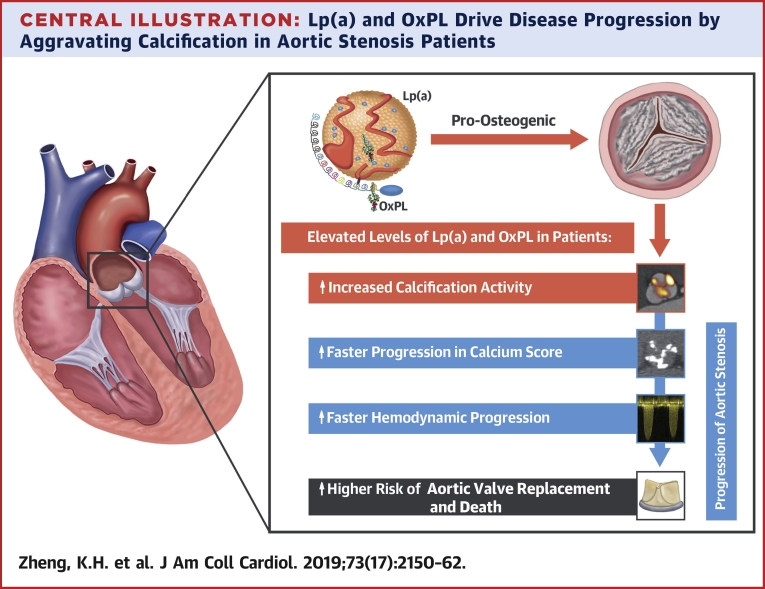
Lp(a), oxidized phospholipids, and valve calcification in 145 patients with aortic stenosis. Patients in the top tertile of Lp(a) or of oxidized phospholipids on apoB had more valve calcification activity on 18F-sodium fluoride positron emission tomography (PET), faster progression of the CT calcium score and of peak aortic jet velocity, and a higher risk of aortic valve replacement or death. Credit: Zheng KH, Tsimikas S, Pawade T, et al., J Am Coll Cardiol 2019;73:2150–2162 (Central Illustration), via PubMed Central, CC BY 4.0.
Lp(a)-lowering trials in aortic stenosis. No completed randomized trial has tested Lp(a) lowering in valve disease. Lp(a)FRONTIERS CAVS (NCT05646381) is randomizing 502 adults aged 50 to less than 80 years with mild or moderate calcific aortic stenosis and Lp(a) of 175 nmol/L or more to monthly subcutaneous pelacarsen 80 mg or placebo. The primary end points are change in peak aortic jet velocity and in aortic valve calcium score. A planned early-phase trial of niacin for aortic valve calcium progression (EAVaLL, NCT02109614) was withdrawn before enrollment. The neutral result of Lp(a)HORIZON leaves the effect of Lp(a) lowering on aortic stenosis untested, a question that concerns an earlier stage of a different disease process.
Heart failure, atrial fibrillation, and diabetes
Heart failure. Lp(a) molar concentration was associated with heart failure in 143,087 Icelanders (Gudbjartsson 2019), and the EAS consensus places the threshold for increased heart failure risk above the 90th percentile in primary prevention (Kronenberg 2022). Because Lp(a) causes myocardial infarction and aortic stenosis, both of which lead to heart failure, much of this association is expected to act through ischemic and valvular disease.
Atrial fibrillation. A meta-analysis of 16 observational studies and 7 Mendelian randomization studies found no association between Lp(a) and atrial fibrillation (observational odds ratio 0.980; Mendelian randomization odds ratio 0.976 when restricted to independent data sets) and concluded that any causal effect is unlikely to be clinically meaningful (Fahim 2026).
Low Lp(a) and type 2 diabetes. Very low Lp(a) concentrations are associated with a higher risk of type 2 diabetes. In Iceland, homozygous carriers of LPA loss-of-function variants had little or no Lp(a) and an increased risk of type 2 diabetes, and the increase was seen in the lowest 10% of concentrations. The authors modeled that lowering Lp(a) in the 20% of people with the highest concentration to the population median would reduce coronary risk without raising diabetes risk (Gudbjartsson 2019). The EAS consensus flagged this association as meriting study and as a concern for drugs that lower Lp(a) profoundly (Kronenberg 2022).
Continuous risk, independence from LDL cholesterol, and residual risk
Lp(a) risk is continuous. The UK Biobank relationship was linear across the distribution, without a threshold below which risk is absent (Patel 2021), and the ERFC described associations that were broadly continuous in shape (ERFC 2009). Clinical cut points such as 125 nmol/L are conventions for decisions, and a value just below a threshold carries nearly the same risk as one just above it.
The association is independent of LDL-C. The EAS consensus concluded that elevated Lp(a) is a risk factor even at very low LDL-C (Kronenberg 2022). In the placebo arm of FOURIER, patients with established ASCVD in the highest quartile of Lp(a) had a higher risk of coronary heart disease death, myocardial infarction, or urgent revascularization (adjusted hazard ratio 1.22 for quartile 4 versus quartile 1) independent of LDL-C (O'Donoghue 2019). In AIM-HIGH, baseline and on-study Lp(a) predicted cardiovascular events in patients treated with simvastatin to an LDL-C of 40 to 80 mg/dL (Albers 2013). In secondary prevention, Lp(a) of 150 nmol/L or more was associated with a smaller relative hazard than in primary prevention (1.16 versus 1.50) because baseline risk from established disease is high (Patel 2021).
Lp(a) and inflammation markers. Earlier analyses raised the possibility that Lp(a) confers risk only when inflammation is present. Analysis of 357,220 UK Biobank participants without ASCVD and 34,020 participants in FOURIER and SAVOR-TIMI 53 showed that higher Lp(a) was associated with major adverse cardiovascular events, myocardial infarction, and PAD regardless of whether hsCRP was below 2 mg/L or 2 mg/L or more. In UK Biobank, the hazard ratio per 50 nmol/L higher Lp(a) was 1.05 in both hsCRP strata (P for interaction 0.80) (Small 2024). The two markers carry separate information: hsCRP identifies residual inflammatory risk, and Lp(a) identifies an inherited lipoprotein risk. Both are risk-enhancing factors in the 2026 guideline; the use of hsCRP is described under biomarkers in risk assessment.
Measurement of lipoprotein(a): units, assays, and isoform effects
Lp(a) is measured by immunoassays that detect apo(a). Two reporting conventions are in use. A molar result in nmol/L expresses particle concentration. A mass result in mg/dL expresses the mass of the whole particle, protein and lipid together. Molar concentration is the attribute of Lp(a) that carries cardiovascular risk (Gudbjartsson 2019). The 2026 ACC/AHA guideline and the National Lipid Association (NLA) state their thresholds as paired values, 125 nmol/L and 50 mg/dL (Blumenthal 2026; Koschinsky 2024), and the 2025 European Society of Cardiology (ESC)/EAS update states its threshold as above 50 mg/dL or above 105 nmol/L (Mach 2025).
Isoform-dependent assay error. Apo(a) size varies between people and within a person, who carries two isoforms. Antibodies directed at epitopes in the KIV-2 repeat bind more often to large isoforms, which carry more copies, than to small ones. An assay with calibrators of a different isoform size from the sample therefore overestimates concentration in people with large isoforms and underestimates it in people with small isoforms, who are the people at highest risk (Marcovina 2016). Isoform-insensitive assays use antibodies directed at a unique, nonrepeated epitope or calibrate with a set of materials spanning isoform sizes. The 2026 guideline recommends that laboratories use assays insensitive to apo(a) isoform size and traceable to reference materials (Blumenthal 2026).
Conversion between mg/dL and nmol/L. The mass of a single Lp(a) particle depends on its apo(a) isoform, so the ratio between a mass result and a molar result differs between people. The EAS consensus suggested a factor of 2.5 nmol/L per mg/dL for approximate conversion (Kronenberg 2022), but no factor is accurate for an individual with an unusually small or large isoform. US guidance therefore interprets a result in the unit in which the laboratory reports it, using the paired thresholds of 125 nmol/L and 50 mg/dL. A molar value calculated from a mass measurement is not a molar measurement.
| Feature | Molar result (nmol/L) | Mass result (mg/dL) |
|---|---|---|
| Quantity measured | Number of Lp(a) particles | Total particle mass (apo(a), apoB, and lipid) |
| Effect of isoform size | Minimal with an isoform-insensitive assay and calibration traceable to reference material | The same particle number gives a higher result with a large isoform |
| Relation to risk | Expresses the quantity that carries risk (Gudbjartsson 2019) | Reflects isoform size as well as particle number |
| Risk-enhancing threshold (ACC/AHA) | 125 nmol/L or more | 50 mg/dL or more |
| Threshold for at least 2-fold risk (ACC/AHA) | 250 nmol/L or more | 100 mg/dL or more |
| Conversion to the other unit | No fixed factor is valid for an individual; results are interpreted in the reported unit | |
Molar and mass reporting of lipoprotein(a) (Blumenthal 2026; Koschinsky 2024; Mach 2025; Marcovina 2016; Kronenberg 2022). Measurement of LDL-C, non-high-density lipoprotein cholesterol (non-HDL-C), and apoB is covered under lipid measurement.
The standard lipid panel does not include Lp(a), which is ordered as a separate test. Assays that measure intact particles and assays that measure apo(a) can diverge during treatment with drugs that block particle assembly: in the phase 2 trial of muvalaplin, which prevents the apo(a)-apoB link, the reduction at the highest dose was 85.8% with an intact-particle assay and 68.9% with a conventional apo(a)-based assay (Nicholls 2025).
Lipoprotein(a) cholesterol inside measured LDL cholesterol
All routine methods for LDL-C, whether calculated by the Friedewald, Martin-Hopkins, or Sampson equations or measured directly, include the cholesterol carried by Lp(a). At ordinary Lp(a) concentrations the contribution is small. At high concentrations, it inflates LDL-C and makes the LDL-C response to a statin appear smaller than the change in true LDL particle cholesterol, because Lp(a) does not fall with statin therapy and often rises modestly.
Estimation of Lp(a) cholesterol. Lp(a) cholesterol has conventionally been estimated as 30% of Lp(a) mass in mg/dL, and corrected LDL-C as measured LDL-C minus that value. The 30% assumption is inaccurate because the cholesterol content of the particle varies with isoform size and because mass assays are imprecise. With the conventional formula, about 7% of samples with low LDL-C produced negative corrected values. A molar formula, Lp(a) cholesterol (mg/dL) = Lp(a) (nmol/L) × 0.077, produced no negative values and avoided the underestimation of corrected LDL-C seen with the conventional formula in people with small isoforms and a high Lp(a)-to-apoB ratio (Rosenson 2024).
| Method | Formula | Limitations |
|---|---|---|
| Conventional mass method | Lp(a) cholesterol = 0.30 × Lp(a) mass (mg/dL); corrected LDL-C = LDL-C − Lp(a) cholesterol | Fixed 30% cholesterol content; depends on mass assay accuracy; negative values at low LDL-C |
| Molar method | Lp(a) cholesterol (mg/dL) = 0.077 × Lp(a) (nmol/L); corrected LDL-C = LDL-C − Lp(a) cholesterol | Derived in 239 participants of one trial; not validated for treatment goals |
| Reported LDL-C without correction | Friedewald, Martin-Hopkins, Sampson, or direct LDL-C | Includes Lp(a) cholesterol; the form in which trial and guideline LDL-C values are expressed |
Methods for estimating the cholesterol carried by lipoprotein(a) (Rosenson 2024; Langsted 2016). Corrected values are interpretive aids.
Consequences for diagnosis and treatment. High Lp(a) can produce a clinical diagnosis of FH. In 46,200 adults of the Copenhagen General Population Study, high Lp(a) cholesterol accounted for a quarter of all individuals diagnosed with clinical FH, and after LDL-C was adjusted for Lp(a) cholesterol, mean Lp(a) no longer differed between those classified as unlikely, possible, or probable or definite FH (Langsted 2016). A patient with very high Lp(a) and an LDL-C that remains above goal on high-intensity statin and ezetimibe may have a corrected LDL-C near goal. The residual risk in that patient is carried by Lp(a). In clinical ASCVD, the guideline-recommended next step is a PCSK9 antibody, which lowers both. The lipoprotein(a) result interpreter estimates Lp(a) cholesterol and corrected LDL-C.
Universal, selective, and cascade testing for lipoprotein(a)
Universal one-time measurement. The 2026 ACC/AHA guideline recommends measurement of Lp(a) at least once in all adults for ASCVD risk assessment (Class 1), the first ACC/AHA recommendation for universal Lp(a) testing (Blumenthal 2026). It replaced the selective approach of the 2018 cholesterol guideline, which had supported measurement mainly with a family history of premature ASCVD. The 2021 Canadian Cardiovascular Society (CCS) guideline recommends measurement once in a person's lifetime as part of the initial lipid screen (Pearson 2021). The 2022 EAS consensus recommends measurement at least once in adults (Kronenberg 2022), and the 2024 NLA focused update recommends measurement at least once in all adults (Koschinsky 2024). The 2025 ESC/EAS focused update states that measurement at least once in a lifetime should be considered (Class IIa) (Mach 2025). After Lp(a)HORIZON, the EAS reaffirmed one-time universal testing to assess risk, guide prevention, and identify affected relatives (Laufs 2026).
Selective indications. The groups in whom measurement is most informative remain the priority where universal testing is not yet implemented:
- premature ASCVD, particularly without explanatory risk factors, or recurrent events despite LDL-C at goal;
- a family history of premature ASCVD or of high Lp(a);
- FH or LDL-C of 190 mg/dL or more, or a poor apparent LDL-C response to statin therapy;
- calcific aortic stenosis, particularly at a younger age, and progressive disease;
- borderline or intermediate estimated risk in which a risk-enhancing factor would change the treatment decision.
Cascade testing. The 2026 guideline recommends cascade testing of first-degree relatives in people with FH, premature ASCVD, or high Lp(a) (Class 1) (Blumenthal 2026). Because inheritance is codominant, testing relatives has a high yield. In the Spanish Familial Hypercholesterolemia Cohort Study (SAFEHEART), screening relatives of index cases with both FH and elevated Lp(a) identified 1 new case of elevated Lp(a) per 2.4 relatives tested, compared with 1 per 5.8 when the index case had FH without elevated Lp(a). Over 5 years, relatives with both FH and elevated Lp(a) had a hazard ratio of 4.40 for an ASCVD event or death compared with those with neither condition (Ellis 2019).
| Document | Who is tested | Cascade testing | Assay and units |
|---|---|---|---|
| ACC/AHA 2026 | All adults at least once (Class 1) | First-degree relatives in FH, premature ASCVD, or high Lp(a) (Class 1) | Isoform-insensitive assays traceable to reference materials; molar units preferred |
| NLA 2024 | All adults at least once | First-degree relatives of patients with elevated Lp(a) | Molar units preferred |
| EAS 2022 and 2026 | All adults at least once | FH, family or personal history of high Lp(a), premature ASCVD | Molar units preferred; approximate factor of 2.5 for conversion |
| ESC/EAS 2025 | Measurement at least once in a lifetime should be considered (Class IIa) | — | Molar preferred; mass acceptable |
| CCS 2021 | Once in a lifetime as part of initial lipid screening | — | — |
Lipoprotein(a) testing recommendations by guideline and consensus document; a dash indicates no position in the published summary (Blumenthal 2026; Koschinsky 2024; Kronenberg 2022; Laufs 2026; Mach 2025; Pearson 2021).
Testing rates and the implementation gap. Before universal testing, Lp(a) was rarely measured in the United States. Across 6 University of California academic medical centers over 10 years, 18,972 of 5,553,654 adults (0.3%) had Lp(a) testing. Rates were 2.9% in people with ischemic heart disease, 3.1% with aortic stenosis, 3.3% with a family history of cardiovascular disease, 1.7% after stroke, and 1.8% among those with a lipid panel (Bhatia 2023). The NLA noted that measurement rates were low despite the high prevalence of elevated Lp(a) (Koschinsky 2024), and AHA clinician guidance on Lp(a) testing addresses test cost and insurance coverage as common patient concerns (AHA 2026).
Repeat measurement and sources of variability
Because Lp(a) is genetically determined and stable within individuals, repeat measurement is generally not needed, and lifestyle change has minimal effect on the level (Blumenthal 2026; ERFC 2009). The NLA notes that specific conditions may warrant repeat testing, especially when the first value is in the intermediate range (Koschinsky 2024). The conditions and drugs in the following table can change the level enough to move a patient across a threshold.
| Condition or drug | Effect on Lp(a) | Implication |
|---|---|---|
| Nephrotic syndrome and peritoneal dialysis | Increase irrespective of isoform size; reversed by remission or transplantation | Repeat after resolution (Hopewell 2018) |
| Chronic kidney disease | Increase in people with large isoforms | Interpreted with kidney function (Hopewell 2018) |
| Inflammation, pregnancy, growth hormone | Increase up to 2- to 3-fold | Value obtained during acute illness or pregnancy is repeated later (Kronenberg 2022) |
| Menopause | Higher after menopause; 17% higher than in men | A premenopausal value can underestimate later levels (Nordestgaard 2024) |
| Oral estrogen with progestin | Mean reduction of 5.8 mg/dL in HERS | Hormone therapy is not prescribed to lower Lp(a) (Shlipak 2000) |
| Statin therapy | Mean increase of 8.5% to 19.6% across trials | On-treatment values are higher (Tsimikas 2020 statins) |
| PCSK9 antibodies and inclisiran | Reduction of about one-quarter | Baseline is preferably measured before therapy (Mulligan 2026) |
Conditions and drugs that change lipoprotein(a) concentration.
Risk thresholds and their interpretation
The ACC/AHA guideline uses two thresholds. A concentration of 125 nmol/L (50 mg/dL) or more is a risk-enhancing factor associated with about 1.4-fold ASCVD risk, and 250 nmol/L (100 mg/dL) or more identifies a substantially higher-risk phenotype with at least 2-fold risk (Blumenthal 2026). The NLA adds a lower band: below 75 nmol/L (30 mg/dL) is low risk, 75 to 124 nmol/L (30 to 49 mg/dL) is intermediate, and 125 nmol/L (50 mg/dL) or more is high risk (Koschinsky 2024). Lipid management at these thresholds is summarized under lipoprotein(a) in dyslipidemia.
| Document | Low or normal | Intermediate | Elevated | Very high |
|---|---|---|---|---|
| ACC/AHA 2026 | Not defined | Not defined | 125 nmol/L (50 mg/dL) or more: risk enhancer, about 1.4-fold risk | 250 nmol/L (100 mg/dL) or more: at least 2-fold risk |
| NLA 2024 | Below 75 nmol/L (30 mg/dL) | 75–124 nmol/L (30–49 mg/dL) | 125 nmol/L (50 mg/dL) or more: high risk | Not separately defined |
| EAS 2022 | Below 30 mg/dL (75 nmol/L) | 30–50 mg/dL | Above 50 mg/dL | About 100 mg/dL (about 250 nmol/L): about 2-fold risk at any baseline risk |
| ESC/EAS 2025 | Not defined | Not defined | Above 50 mg/dL (above 105 nmol/L): risk modifier (Class IIa); can move moderate risk to high risk | Not defined |
| CCS 2021 | Not defined | Not defined | 50 mg/dL (100 nmol/L) or more | Not defined |
Lipoprotein(a) thresholds in US, European, and Canadian guidance (Blumenthal 2026; Koschinsky 2024; Kronenberg 2022; Mach 2025; Pearson 2021). The paired units are those stated by the documents and do not represent a conversion.
The EAS consensus framed elevated Lp(a) as a factor that scales with baseline risk. Because Lp(a) multiplies baseline risk, the absolute increase is largest when baseline risk is high, and an Lp(a) of about 100 mg/dL roughly doubles risk regardless of the baseline. The EAS considered that Lp(a) contributes little to population-level discrimination in risk algorithms and can change estimated risk substantially in individuals with high values (Kronenberg 2022).
Lipoprotein(a) in global risk assessment and with coronary calcium
In the 2026 ACC/AHA framework (calculate, personalize, reclassify), 10-year risk is estimated with the American Heart Association Predicting Risk of cardiovascular disease EVENTs (PREVENT)-ASCVD equations in adults aged 30 to 79 years without ASCVD, and risk-enhancing factors personalize the estimate. In adults with a borderline 10-year risk of 3% to less than 5%, consideration of risk enhancers is reasonable to personalize risk and the potential benefit of lipid-lowering therapy (Class 2a). The same factors are evaluated at intermediate risk of 5% to less than 10% (Blumenthal 2026). Lp(a) of 125 nmol/L (50 mg/dL) or more is one of these risk enhancers. The PREVENT equations and the full list of risk enhancers are covered under cardiovascular risk assessment.
Quantitative adjustment of risk. PREVENT does not include Lp(a). Because the UK Biobank association was linear, with a hazard ratio of 1.11 per 50 nmol/L (Patel 2021), a 10-year risk estimate can be adjusted approximately as risk × 1.11^(Lp(a) in nmol/L ÷ 50) (Patel 2021; Finneran 2021). For a 10-year risk of 10% and an Lp(a) of 250 nmol/L, the adjusted estimate is 10% × 1.11^5, or about 16.9%. The adjustment is an approximation: it assumes the risk equation reflects a person with negligible Lp(a), it applies only to molar results, and it has not been tested as a treatment threshold.
Coronary artery calcium. Lp(a) and coronary artery calcium (CAC) provide independent information. In 4,512 MESA participants followed for 13.2 years, elevated Lp(a), defined as the highest race-specific quintile, was associated with a hazard ratio of 1.29 for ASCVD. CAC scores of 1 to 99 and 100 or more carried hazard ratios of 1.68 and 2.66, with no interaction between Lp(a) and CAC. Compared with participants with neither finding, those with elevated Lp(a) and CAC of 100 or more had a hazard ratio of 4.71, and those with elevated Lp(a) and CAC of 0 had a hazard ratio of 1.31 (95% CI 0.73–2.35), similar to the reference group. Findings were replicated in the Dallas Heart Study (Mehta 2022). A CAC score of 0 therefore indicates lower near-term risk in a patient with elevated Lp(a) over the follow-up studied. The lifelong risk carried by an inherited factor and the indication for cascade testing remain. CAC-based goals and reassessment intervals are covered under coronary calcium and LDL-C goals.
Lipoprotein(a) result interpreter and risk adjustment
The interpreter classifies a result in the unit reported by the laboratory, without converting between mass and molar units, and lists the guideline actions that follow. It also estimates Lp(a) cholesterol and corrected LDL-C, tests the FDA apheresis criterion in either unit (60 mg/dL or 130 nmol/L, both stated in the device labeling), and applies the per-50-nmol/L risk adjustment to an entered 10-year PREVENT-ASCVD risk.
Lipoprotein(a) result interpreter
Adults; one result in its reported unitCategories: below 75 nmol/L (30 mg/dL), 75–124 nmol/L (30–49 mg/dL), 125 nmol/L (50 mg/dL) or more, and 250 nmol/L (100 mg/dL) or more (Blumenthal 2026; Koschinsky 2024). Lp(a) cholesterol = 0.077 × nmol/L (Rosenson 2024) or 0.30 × mg/dL (conventional). Adjusted risk = PREVENT-ASCVD 10-year risk × 1.11^(Lp(a) nmol/L ÷ 50) (Patel 2021; Finneran 2021); the adjustment is omitted in ASCVD and for mass results. FDA apheresis Group D (January 2025 labeling): clinically diagnosed heterozygous FH with documented coronary or peripheral artery disease and Lp(a) of 60 mg/dL (130 nmol/L) or more despite diet and maximal drug therapy (FDA 2025). No mg/dL to nmol/L conversion is performed, because particle mass varies with apo(a) isoform size.
Management of elevated lipoprotein(a)
No therapy that specifically lowers Lp(a) has been shown to reduce cardiovascular events, and the first outcome trial of a selective Lp(a)-lowering drug was neutral. Management therefore reduces the risk that accompanies Lp(a) by lowering apoB-containing lipoproteins and controlling all other modifiable risk factors, beginning earlier and continuing longer than the conventional risk estimate alone would indicate.
Lifestyle. Diet and physical activity change Lp(a) minimally (Blumenthal 2026). Their benefit in a patient with elevated Lp(a) comes from lowering LDL-C, blood pressure, glucose, and weight, which lowers the absolute risk to which Lp(a) adds.
Primary prevention. In the guideline algorithm for elevated Lp(a) (125 nmol/L [50 mg/dL] or more), all individuals receive optimal early control of modifiable cardiovascular risk factors (Blumenthal 2026). An ACC Cardiology Magazine feature on applying the guideline recommends early control of all risk factors, including LDL-C below 70 mg/dL, and family screening for adults with Lp(a) of 125 nmol/L or more (ACC 2026). In borderline-risk adults, consideration of risk enhancers such as elevated Lp(a) in the decision to start lipid-lowering therapy is reasonable (Class 2a), and the same factors are weighed at intermediate risk (Blumenthal 2026). The EAS estimate that the risk of an Lp(a) about 50 mg/dL higher is offset by an LDL-C about 21 mg/dL lower quantifies the LDL-C reduction that compensates for a given Lp(a) burden (Kronenberg 2022).
Clinical ASCVD. In patients with clinical ASCVD and elevated Lp(a), LDL-C and non-HDL-C goals are pursued with maximally tolerated statin therapy, and when they are not met, addition of a PCSK9 monoclonal antibody with proven cardiovascular benefit is recommended (Class 1) (Blumenthal 2026). The recommendation is consistent with the larger absolute benefit of PCSK9 antibodies in patients with high Lp(a) in FOURIER and ODYSSEY OUTCOMES. The same ACC feature considers a PCSK9 inhibitor reasonable as the first escalation step after a statin in severe hypercholesterolemia or ASCVD with elevated Lp(a), although drug plans may require ezetimibe first (ACC 2026). Drug sequencing for LDL-C lowering is described under nonstatin sequencing.
Familial hypercholesterolemia with high Lp(a). In the Copenhagen General Population Study, compared with people unlikely to have FH and with Lp(a) of 50 mg/dL or less, hazard ratios for myocardial infarction were 1.4 with Lp(a) above 50 mg/dL alone, 3.2 with clinical FH alone, and 5.3 with both (Langsted 2016). People with both conditions are at the highest inherited risk and receive the most intensive LDL-C lowering, cascade testing for both disorders, and evaluation for apheresis when disease progresses despite maximal therapy.
Effects of lipid-lowering and other drugs on lipoprotein(a)
Most lipid drugs have small or no effects on Lp(a), and those that lower it by a quarter or more also lower LDL-C, so their outcome benefits cannot be assigned to Lp(a) alone. Effects of nonstatin LDL-lowering drugs on LDL-C and their outcome trials are covered under nonstatin LDL-lowering therapies.
| Drug or class | Effect on Lp(a) | Outcome evidence and clinical role |
|---|---|---|
| Statins | Increase; mean change 8.5% to 19.6% with statin versus −0.4% to −2.3% with placebo; ratio of geometric means 1.11 | Statins reduce events in patients with high Lp(a); the increase does not contraindicate them (Tsimikas 2020 statins) |
| PCSK9 antibodies (evolocumab, alirocumab) | Median reduction 26.9% with evolocumab in FOURIER | Larger absolute benefit above median Lp(a); Class 1 in ASCVD with elevated Lp(a) above LDL-C goal (O'Donoghue 2019; Blumenthal 2026) |
| PCSK9-targeted agents pooled (antibodies, inclisiran, enlicitide, lerodalcibep) | Pooled reduction 25.8% across 31 trials; no significant difference between agents | Agent choice based on factors other than Lp(a) lowering (Mulligan 2026) |
| Niacin (extended release) | Reduction of 21% at 1 year in AIM-HIGH | No reduction in events on statin in AIM-HIGH (Albers 2013) or HPS2-THRIVE (niacin trials); not used for Lp(a) |
| Cholesteryl ester transfer protein (CETP) inhibitors | Obicetrapib: placebo-adjusted reduction 37.3% (14.9 nmol/L) in pooled trials | Larger absolute reduction at higher baseline Lp(a); no Lp(a)-specific outcome data (Nicholls 2026) |
| Mipomersen (apoB antisense) | Median reduction 26.4% versus 0.0% with placebo at 28 weeks in 4 phase 3 trials | No outcome data; not used for Lp(a) (Santos 2015) |
| Lomitapide (microsomal triglyceride transfer protein inhibitor) | Reduction of 15% to 19% in early trials, through reduced apoB secretion | Restricted to homozygous FH; no role for Lp(a) (Sahebkar 2013) |
| Estrogen with progestin | Mean reduction 5.8 mg/dL in HERS | Not prescribed for Lp(a) or for cardiovascular prevention (Shlipak 2000) |
| Antisense, small interfering RNA, and oral assembly inhibitors | Reductions of 35% to more than 95%, by agent and dose | Investigational; described under Lp(a)-lowering drugs in development |
Effects of lipid-modifying and hormonal drugs on lipoprotein(a) concentration.
PCSK9 antibodies and Lp(a). In FOURIER, evolocumab reduced coronary heart disease death, myocardial infarction, or urgent revascularization by 23% (hazard ratio 0.77) in patients with baseline Lp(a) above the median of 37 nmol/L and by 7% (hazard ratio 0.93) at or below the median (P for interaction 0.07). The 3-year absolute risk reductions were 2.49% and 0.95%, with numbers needed to treat of 40 and 105 (O'Donoghue 2019). A similar pattern was reported for alirocumab in ODYSSEY OUTCOMES, as summarized under PCSK9 antibodies. These are subgroup analyses, and the absolute Lp(a) reductions were small; the PCSK9 recommendation rests on LDL-C lowering in a group at higher absolute risk.
Statins in patients with high Lp(a). Statins raise Lp(a) modestly, and an LDL-C response that appears smaller than expected may reflect the Lp(a) cholesterol included in the measurement. Statins remain the foundation of LDL-C lowering in patients with high Lp(a). The LDL-C response to statins is described under statins.
Lipoprotein apheresis for elevated lipoprotein(a)
Lipoprotein apheresis removes apoB-containing lipoproteins, LDL and Lp(a) together, from plasma or whole blood in an extracorporeal circuit, usually at weekly or 2-week intervals. The techniques, rebound kinetics, and adverse effects are described under lipoprotein apheresis.
FDA criterion for Lp(a). In April 2020, the FDA added Group D to the indications of the Liposorber LA-15 system: functional hypercholesterolemic heterozygotes with LDL-C of 100 mg/dL or more, Lp(a) of 60 mg/dL or more, and documented coronary or peripheral artery disease (FDA 2020). A January 2025 revision of the indications removed the LDL-C criterion. Group D now covers clinically diagnosed heterozygous FH with documented coronary or peripheral artery disease and Lp(a) of 60 mg/dL (130 nmol/L) or more, in patients for whom diet and maximum drug therapy have been ineffective or not tolerated (FDA 2025; Blumenthal 2026). The other indication groups (homozygous FH and heterozygous FH by LDL-C level) are listed under lipoprotein apheresis.
Evidence. No randomized trial has tested apheresis for Lp(a). In Germany, Lp(a) hyperlipoproteinemia with progressive cardiovascular disease has been an approved indication for apheresis since 2008. The prospective Pro(a)LiFe study followed 170 German patients with a mean Lp(a) of 108.1 mg/dL and progressive disease despite maximal treatment of LDL-C (mean measured LDL-C 98.9 mg/dL; corrected 66.3 mg/dL). A single session lowered Lp(a) by 68.1% on average, and the mean annual rate of cardiovascular events fell from 0.58 in the 2 years before regular apheresis to 0.11 afterward (P < 0.0001) (Roeseler 2016). The before-after design cannot exclude regression to the mean, concurrent therapy changes, and selection of patients after a cluster of events. The EAS consensus regards apheresis as an option for very high Lp(a) with progressive cardiovascular disease despite optimal management of risk factors (Kronenberg 2022).
Aspirin and elevated lipoprotein(a)
The plasminogen-like structure of apo(a) and its proposed antifibrinolytic effect led to the hypothesis that aspirin offsets part of the Lp(a)-associated risk. The evidence comes from genotype and subgroup analyses of primary prevention trials and observational cohorts.
The Aspirin in Reducing Events in the Elderly (ASPREE) trial included 12,815 genotyped participants of European ancestry aged 70 years or older. Among them, carriers of rs3798220-C had a higher risk of major adverse cardiovascular events on placebo (hazard ratio 1.90) and no increase on aspirin (hazard ratio 0.54), with a borderline interaction (P = 0.049). In carriers, aspirin reduced events by 11.4 per 1,000 person-years without a significant increase in bleeding. For a high LPA genetic risk score, the interaction was not significant. In all participants, aspirin reduced major adverse cardiovascular events by 1.7 and increased clinically significant bleeding by 1.7 per 1,000 person-years (Lacaze 2022). A meta-analysis of 6 studies (6,628 participants) found no significant reduction in major adverse cardiovascular events with aspirin among adults without ASCVD who had Lp(a) of 50 mg/dL or more or high-risk LPA genotypes (hazard ratio 0.60; 95% CI 0.31–1.17). Bleeding risk was numerically higher with aspirin (hazard ratio 1.24) (Lopes 2026).
The EAS consensus does not recommend aspirin to offset Lp(a)-related risk (Kronenberg 2022). Aspirin for primary prevention is decided on overall atherosclerotic and bleeding risk, as described under aspirin in primary prevention; elevated Lp(a) is one consideration in that decision and is not by itself an indication. In secondary prevention, antiplatelet therapy follows the indication of the underlying disease.
Lipoprotein(a)-lowering drugs in development
Selective Lp(a)-lowering drugs act on LPA expression in the hepatocyte or on particle assembly. Antisense oligonucleotides and small interfering RNAs target LPA messenger RNA and reduce apo(a) synthesis; the oral agent blocks the binding of apo(a) to apoB.
Pelacarsen is an antisense oligonucleotide that binds LPA messenger RNA and promotes its degradation. In a phase 2 dose-ranging trial in 286 patients with cardiovascular disease and Lp(a) of at least 60 mg/dL (150 nmol/L), Lp(a) fell by a mean of 35% with 20 mg at 4-week intervals, 56% with 40 mg at 4-week intervals, 58% with 20 mg at 2-week intervals, 72% with 60 mg at 4-week intervals, and 80% with 20 mg weekly, compared with 6% with placebo. Injection-site reactions were the most common adverse event (Tsimikas 2020).
Olpasiran is a small interfering RNA. In OCEAN(a)-DOSE, 281 patients with ASCVD and Lp(a) above 150 nmol/L (median 260.3 nmol/L) received olpasiran or placebo. Placebo-adjusted mean changes at 36 weeks were −70.5% with 10 mg, −97.4% with 75 mg, −101.1% with 225 mg at 12-week intervals, and −100.5% with 225 mg at 24-week intervals (O'Donoghue 2022).
Lepodisiran is an extended-duration small interfering RNA. In ALPACA, 320 participants with a median Lp(a) of 253.9 nmol/L were randomized. The placebo-adjusted time-averaged reduction from day 60 to day 180 was 93.9 percentage points with 400 mg, and from day 30 to day 360 it was 94.8 percentage points with 2 doses of 400 mg 180 days apart (Nissen 2025 lepodisiran).
Zerlasiran is a small interfering RNA. In 178 patients with stable ASCVD and Lp(a) of 125 nmol/L or more (median 213 nmol/L), placebo-adjusted time-averaged reductions to week 36 were 85.6% with 450 mg at 24-week intervals, 82.8% with 300 mg at 16-week intervals, and 81.3% with 300 mg at 24-week intervals (Nissen 2024 zerlasiran).
Muvalaplin is an oral small molecule that blocks the binding of apo(a) to apoB and so prevents particle formation. In 233 participants with Lp(a) of 175 nmol/L or more and ASCVD, diabetes, or FH, placebo-adjusted reductions at 12 weeks with an intact-particle assay were 47.6% with 10 mg, 81.7% with 60 mg, and 85.8% with 240 mg daily; apoB fell by up to 16.1%, and hsCRP did not change (Nicholls 2025).
| Agent | Mechanism and route | Phase 2 Lp(a) reduction | Cardiovascular outcome trial |
|---|---|---|---|
| Pelacarsen | Antisense oligonucleotide; subcutaneous monthly (80 mg in phase 3) | 35% to 80% by dose (mean) | Lp(a)HORIZON: completed, neutral |
| Olpasiran | Small interfering RNA; subcutaneous at 12- or 24-week intervals | 70.5% to 101.1% placebo-adjusted | OCEAN(a)-Outcomes and OCEAN(a)-PreEvent: ongoing |
| Lepodisiran | Extended-duration small interfering RNA; subcutaneous doses 180 days apart in phase 2 | 93.9 percentage points placebo-adjusted (400 mg) | ACCLAIM-Lp(a): ongoing |
| Zerlasiran | Small interfering RNA; subcutaneous at 16- or 24-week intervals | 81.3% to 85.6% placebo-adjusted | No phase 3 outcome trial registered |
| Muvalaplin | Oral inhibitor of apo(a)-apoB binding; daily | 47.6% to 85.8% placebo-adjusted (intact-particle assay) | MOVE-Lp(a): ongoing |
Selective lipoprotein(a)-lowering agents (Tsimikas 2020; O'Donoghue 2022; Nissen 2025 lepodisiran; Nissen 2024 zerlasiran; Nicholls 2025). Trial status from ClinicalTrials.gov registrations.
Lp(a)HORIZON: pelacarsen and cardiovascular outcomes
Lp(a)HORIZON (NCT04023552) was the first cardiovascular outcome trial of a selective Lp(a)-lowering drug. It randomized patients with preexisting cardiovascular disease and Lp(a) of at least 70 mg/dL in a 1:1 ratio to subcutaneous pelacarsen 80 mg monthly or placebo on background therapy. The primary end point was major adverse cardiovascular events: death from cardiovascular causes, nonfatal myocardial infarction, nonfatal stroke, or urgent coronary revascularization. A second primary population comprised patients with Lp(a) of at least 90 mg/dL (Cho 2026).
| Measure | Pelacarsen | Placebo | Effect |
|---|---|---|---|
| Patients in the efficacy analysis | 4,157 | 4,165 | 8,350 randomized; mean age 59.7 years; 27.0% women |
| Median baseline Lp(a) | 236 nmol/L | Entry threshold 70 mg/dL | |
| Lp(a) at 12 months | 64.4 nmol/L | 233.4 nmol/L | About 78% lower with pelacarsen (Laufs 2026) |
| Primary end point, all patients | 511 (12.3%) | 503 (12.1%) | Hazard ratio 1.02 (95% CI 0.90–1.15); P = 0.76 |
| Primary end point, Lp(a) 90 mg/dL or more | 402 of 3,266 (12.3%) | 403 of 3,274 (12.3%) | Hazard ratio 1.00 (95% CI 0.87–1.15); P = 0.99 |
| Serious adverse events | 1,553 of 4,166 (37.3%) | 1,709 of 4,154 (41.1%) | No excess with pelacarsen |
| Median follow-up | 4.7 years | ||
Principal results of Lp(a)HORIZON, a trial funded by Novartis (Cho 2026; Laufs 2026).
Extended analyses. The further analyses published with the trial showed no association between pelacarsen and the primary end point in any analysis set. Among participants on treatment, the hazard ratio was 0.98 (95% CI 0.85–1.12); among those with uninterrupted treatment, 1.09 (95% CI 0.89–1.34). Total primary end point events, first and recurrent, numbered 644 with pelacarsen and 646 with placebo (rate ratio 1.00). In landmark analyses from 3 months, there was no association between pelacarsen and the primary end point in participants with an Lp(a) reduction at or above the median of 170 nmol/L (hazard ratio 1.09) or in those who achieved an Lp(a) at or below the median of 69.5 nmol/L (hazard ratio 1.10). Results did not differ by baseline Lp(a), LDL-C, hsCRP, or time from the qualifying event (Nissen 2026).
Interpretation. The trial tested pelacarsen in secondary prevention on background therapy, with median Lp(a) falling from 236 nmol/L to 64.4 nmol/L at 12 months, and half of participants in the landmark analysis had an absolute reduction of 170 nmol/L or more. The result shows that this drug, at this dose, in this population, did not reduce events over a median of 4.7 years. It does not overturn the genetic evidence that lifelong high Lp(a) causes atherosclerosis and aortic stenosis. The EAS reaffirmed Lp(a) as a genetically determined risk modifier independent of LDL-C, maintained its recommendation for one-time universal testing to guide prevention and family screening, and identified unresolved questions for future trials (Laufs 2026). The remaining outcome trials differ from Lp(a)HORIZON in mechanism, depth and duration of lowering, entry threshold, end point composition, and inclusion of primary prevention.
Practical consequences. Lp(a) testing, risk interpretation, cascade testing, and LDL-C-based management are unchanged, because they rest on the genetic and epidemiologic evidence of risk. No selective Lp(a)-lowering drug is approved for clinical use.
Ongoing outcome and imaging trials of lipoprotein(a) lowering
| Trial (registration) | Agent | Population and Lp(a) entry threshold | Primary end point | Registered enrollment |
|---|---|---|---|---|
| OCEAN(a)-Outcomes (NCT05581303) | Olpasiran | Age 18 to 85 years; myocardial infarction or PCI with an additional risk factor; 200 nmol/L or more | Coronary heart disease death, myocardial infarction, or urgent coronary revascularization | 7,297; enrollment closed |
| OCEAN(a)-PreEvent (NCT07136012) | Olpasiran | Age 50 years or older without prior atherothrombotic event or revascularization; multiple risk factors or atherosclerosis; 200 nmol/L or more | Coronary heart disease death, myocardial infarction, or urgent coronary revascularization | 11,000; recruiting |
| ACCLAIM-Lp(a) (NCT06292013) | Lepodisiran | Established ASCVD, or age 55 years or older at risk for a first event; 175 nmol/L or more | Major adverse cardiac events (4-component composite) | 17,300; enrollment closed |
| MOVE-Lp(a) (NCT07157774) | Muvalaplin | Prior ASCVD event within 10 years, or at risk for a first event; 175 nmol/L or more | Major adverse cardiac events (4-component composite) | 10,450; recruiting |
| Lp(a)FRONTIERS CAVS (NCT05646381) | Pelacarsen | Age 50 to less than 80 years; mild or moderate calcific aortic stenosis; 175 nmol/L or more | Change in peak aortic jet velocity and aortic valve calcium score | 502; recruiting |
| OCEAN(a)-CCTA (NCT07293260) | Olpasiran | Adults with elevated Lp(a); coronary CT angiography plaque trial | Change in noncalcified plaque volume at 72 weeks | 406; recruiting |
| ACCLAIM-CTA (NCT07613294) | Lepodisiran | Adults with elevated Lp(a) | Percent change in noncalcified plaque volume | 252; recruiting |
Registered phase 3 cardiovascular outcome, valve, and plaque imaging trials of lipoprotein(a) lowering, from ClinicalTrials.gov records. PCI denotes percutaneous coronary intervention.
Three of the outcome trials (OCEAN(a)-PreEvent, ACCLAIM-Lp(a), and MOVE-Lp(a)) enroll primary prevention participants, which Lp(a)HORIZON did not. The two olpasiran outcome trials use a coronary composite that excludes stroke. Pelacarsen has also been studied in US Black and Hispanic participants with ASCVD and Lp(a) of 125 nmol/L or more (Lp(a)FRONTIERS EXPANSION, NCT06267560), a population with higher median concentrations.
Lipoprotein(a) in familial hypercholesterolemia, kidney disease, women, and older adults
Familial hypercholesterolemia. Elevated Lp(a) is common in clinical FH, partly because high Lp(a) cholesterol raises measured LDL-C into the diagnostic range (Langsted 2016). Lp(a) is measured in all patients with FH, both because it identifies the subset at highest risk and because a high value can explain a clinical FH phenotype without a pathogenic variant. Lp(a) is measured during FH cascade screening, which detects additional relatives with elevated Lp(a) (Ellis 2019). FH diagnosis and genetics are covered under familial hypercholesterolemia.
Chronic kidney disease and dialysis. Lp(a) rises with declining kidney function in people with large isoforms. In the nephrotic syndrome and peritoneal dialysis, it rises irrespective of isoform, and the increase reverses after transplantation (Hopewell 2018). Values measured during heavy proteinuria are repeated after remission. Lipid management in kidney disease is covered under lipids in chronic kidney disease.
Women. Lp(a) is higher in women after menopause, and oral estrogen with progestin lowers it modestly without a corresponding reduction in events (Nordestgaard 2024; Shlipak 2000). A premenopausal measurement may underestimate later values. Pregnancy raises Lp(a), so measurement during pregnancy is deferred.
Older adults. In adults aged 70 years or older, the ASPREE genotype analysis is the main source of data on aspirin and Lp(a) (Lacaze 2022). The decision to intensify LDL-C lowering for elevated Lp(a) in older adults follows the same balance of absolute risk, life expectancy, and treatment burden as other statin decisions.
Ancestry. Black adults have the highest median concentrations, so a larger share exceed 125 nmol/L, while the risk per 50 nmol/L is similar across ancestry groups (Patel 2021). South Asian ancestry is itself a risk enhancer in the 2026 guideline, independent of Lp(a).
Guideline positions on lipoprotein(a) compared
| Element | ACC/AHA 2026 | NLA 2024 | EAS 2022 and 2026 | ESC/EAS 2025 |
|---|---|---|---|---|
| Testing | All adults at least once (Class 1) | All adults at least once | All adults at least once; reaffirmed after Lp(a)HORIZON | At least once in a lifetime (Class IIa) |
| Cascade testing | FH, premature ASCVD, or high Lp(a) (Class 1) | Relatives of patients with elevated Lp(a) | FH, family or personal history of high Lp(a), premature ASCVD | — |
| Elevated threshold | 125 nmol/L (50 mg/dL); 250 nmol/L (100 mg/dL) higher risk | 125 nmol/L (50 mg/dL); 75–124 nmol/L intermediate | Above 50 mg/dL | Above 50 mg/dL (above 105 nmol/L) (Class IIa) |
| Role in risk estimation | Risk-enhancing factor | High-risk marker | Scales with baseline risk | Risk modifier; moderate risk can move to high |
| Drug therapy | PCSK9 antibody in ASCVD above goal on statin (Class 1) | Early, more intensive LDL-C lowering | Early intensive risk factor management; PCSK9 inhibitors and niacin not recommended for Lp(a) lowering | Lp(a) reduction not yet shown to reduce ASCVD |
| Apheresis | FDA indications listed: Lp(a) 60 mg/dL (130 nmol/L) or more with heterozygous FH and CAD or PAD | FDA criterion as of 2020 (Lp(a) 60 mg/dL or more, LDL-C 100 mg/dL or more, FH, and CAD or PAD) | Option for very high Lp(a) with progressive disease | — |
| Aspirin | — | — | Not recommended to offset Lp(a) risk | — |
Lipoprotein(a) recommendations compared; a dash indicates no position in the published summary (Blumenthal 2026; Koschinsky 2024; Kronenberg 2022; Laufs 2026; Mach 2025). The 2021 Canadian guideline recommends one lifetime measurement and treats 50 mg/dL (100 nmol/L) or more as elevated (Pearson 2021). CAD denotes coronary artery disease.
Sources of error in lipoprotein(a) testing and management
- Conversion of a mass result in mg/dL to nmol/L with a fixed factor and interpretation against the molar threshold; the result is interpreted in its reported unit against its own threshold.
- Repeated measurement of Lp(a) to monitor lifestyle change or statin therapy; diet and exercise change it minimally, and statins raise it modestly.
- A first measurement during acute illness, the nephrotic syndrome, or pregnancy, which can raise the value; a borderline result obtained in these settings is repeated after recovery.
- Omission of cascade testing after an elevated result; in SAFEHEART, testing relatives of index cases with FH and elevated Lp(a) found 1 new case per 2.4 relatives tested.
- Attribution of a poor apparent LDL-C response to nonadherence or statin resistance without measuring Lp(a), whose cholesterol is included in measured LDL-C.
- A diagnosis of familial hypercholesterolemia from LDL-C alone in a patient with very high Lp(a); a quarter of clinical FH diagnoses in one population cohort were attributable to Lp(a) cholesterol.
- Reassurance from a CAC score of 0 that ends evaluation in a young adult with very high Lp(a); the inherited risk is lifelong and relatives still require testing.
- Prescription of niacin or hormone therapy to lower Lp(a); neither reduces events.
- Aspirin for primary prevention on the basis of elevated Lp(a) alone, without assessment of bleeding risk.
- Inclusion of Lp(a) in a thrombophilia evaluation for venous thromboembolism; genetic evidence does not link it to venous thrombosis.
- Withholding statins because they raise Lp(a); statins remain the foundation of LDL-C lowering in these patients.
- Treatment of the Lp(a)HORIZON result as evidence that Lp(a) testing is no longer useful; testing guides LDL-C intensity, cascade testing, and eligibility for ongoing trials.
References
- Blumenthal RS, Morris PB, Gaudino M, et al. 2026 ACC/AHA/AACVPR/ABC/ACPM/ADA/AGS/APhA/ASPC/NLA/PCNA guideline on the management of dyslipidemia: a report of the American College of Cardiology/American Heart Association Joint Committee on Clinical Practice Guidelines. J Am Coll Cardiol. 2026;87:2624–2757. doi:10.1016/j.jacc.2025.11.016 (also published in Circulation. 2026;153(17), doi:10.1161/CIR.0000000000001423)
- Koschinsky ML, Bajaj A, Boffa MB, et al. A focused update to the 2019 NLA scientific statement on use of lipoprotein(a) in clinical practice. J Clin Lipidol. 2024;18:e308–e319. doi:10.1016/j.jacl.2024.03.001
- Kronenberg F, Mora S, Stroes ESG, et al. Lipoprotein(a) in atherosclerotic cardiovascular disease and aortic stenosis: a European Atherosclerosis Society consensus statement. Eur Heart J. 2022;43:3925–3946. doi:10.1093/eurheartj/ehac361
- Laufs U, Nordestgaard BG, Mora S, et al. The clinical relevance of lipoprotein(a) in the post-Lp(a)HORIZON era: a statement of the European Atherosclerosis Society. Atherosclerosis. 2026;423:121955. doi:10.1016/j.atherosclerosis.2026.121955
- Mach F, Koskinas KC, Roeters van Lennep JE, et al. 2025 focused update of the 2019 ESC/EAS guidelines for the management of dyslipidaemias. Eur Heart J. 2025;46:4359–4378. doi:10.1093/eurheartj/ehaf190 (correction: Eur Heart J. 2026;47:697)
- Pearson GJ, Thanassoulis G, Anderson TJ, et al. 2021 Canadian Cardiovascular Society guidelines for the management of dyslipidemia for the prevention of cardiovascular disease in adults. Can J Cardiol. 2021;37:1129–1150. doi:10.1016/j.cjca.2021.03.016
- Cho L, Nicholls SJ, Frndak S, et al. Pelacarsen and cardiovascular outcomes in patients with high lipoprotein(a) (Lp(a)HORIZON randomized trial). N Engl J Med. 2026. Published online November 7, 2026. doi:10.1056/NEJMoa2610159
- Nissen SE, Cho L, Frndak S, et al. Extended analyses of pelacarsen and cardiovascular outcomes in patients with high lipoprotein(a) (Lp(a)HORIZON randomized trial). NEJM Evid. 2026;5(12):EVIDoa2600373. doi:10.1056/EVIDoa2600373
- Tsimikas S, Karwatowska-Prokopczuk E, Gouni-Berthold I, et al. Lipoprotein(a) reduction in persons with cardiovascular disease (AKCEA-APO(a)-LRx randomized trial). N Engl J Med. 2020;382:244–255. doi:10.1056/NEJMoa1905239
- O'Donoghue ML, Rosenson RS, Gencer B, et al. Small interfering RNA to reduce lipoprotein(a) in cardiovascular disease (OCEAN(a)-DOSE randomized trial). N Engl J Med. 2022;387:1855–1864. doi:10.1056/NEJMoa2211023
- Nissen SE, Ni W, Shen X, et al. Lepodisiran, a long-duration small interfering RNA targeting lipoprotein(a) (ALPACA randomized trial). N Engl J Med. 2025;392:1673–1683. doi:10.1056/NEJMoa2415818
- Nissen SE, Wang Q, Nicholls SJ, et al. Zerlasiran, a small-interfering RNA targeting lipoprotein(a): a phase 2 randomized clinical trial (ALPACAR-360). JAMA. 2024;332:1992–2002. doi:10.1001/jama.2024.21957
- Nicholls SJ, Ni W, Rhodes GM, et al. Oral muvalaplin for lowering of lipoprotein(a): a randomized clinical trial (KRAKEN). JAMA. 2025;333:222–231. doi:10.1001/jama.2024.24017
- Clarke R, Peden JF, Hopewell JC, et al. Genetic variants associated with Lp(a) lipoprotein level and coronary disease. N Engl J Med. 2009;361:2518–2528. doi:10.1056/NEJMoa0902604
- Kamstrup PR, Tybjaerg-Hansen A, Steffensen R, Nordestgaard BG. Genetically elevated lipoprotein(a) and increased risk of myocardial infarction. JAMA. 2009;301:2331–2339. doi:10.1001/jama.2009.801
- Emerging Risk Factors Collaboration; Erqou S, Kaptoge S, Perry PL, et al. Lipoprotein(a) concentration and the risk of coronary heart disease, stroke, and nonvascular mortality. JAMA. 2009;302:412–423. doi:10.1001/jama.2009.1063
- Patel AP, Wang M, Pirruccello JP, et al. Lp(a) (lipoprotein[a]) concentrations and incident atherosclerotic cardiovascular disease: new insights from a large national biobank. Arterioscler Thromb Vasc Biol. 2021;41:465–474. doi:10.1161/ATVBAHA.120.315291
- Finneran P, Pampana A, Khetarpal SA, et al. Lipoprotein(a) and coronary artery disease risk without a family history of heart disease. J Am Heart Assoc. 2021;10:e017470. doi:10.1161/JAHA.120.017470
- Thanassoulis G, Campbell CY, Owens DS, et al. Genetic associations with valvular calcification and aortic stenosis. N Engl J Med. 2013;368:503–512. doi:10.1056/NEJMoa1109034
- Kamstrup PR, Tybjærg-Hansen A, Nordestgaard BG. Elevated lipoprotein(a) and risk of aortic valve stenosis in the general population. J Am Coll Cardiol. 2014;63:470–477. doi:10.1016/j.jacc.2013.09.038
- Kamstrup PR, Tybjærg-Hansen A, Nordestgaard BG. Genetic evidence that lipoprotein(a) associates with atherosclerotic stenosis rather than venous thrombosis. Arterioscler Thromb Vasc Biol. 2012;32:1732–1741. doi:10.1161/ATVBAHA.112.248765
- Gudbjartsson DF, Thorgeirsson G, Sulem P, et al. Lipoprotein(a) concentration and risks of cardiovascular disease and diabetes. J Am Coll Cardiol. 2019;74:2982–2994. doi:10.1016/j.jacc.2019.10.019
- Fahim M, Eldawud D, Wang R, et al. Lipoprotein(a) and atrial fibrillation: meta-analysis of observational and mendelian randomization studies shows no clinically meaningful association. J Clin Lipidol. 2026;20:1965–1977. doi:10.1016/j.jacl.2026.07.006
- Small AM, Pournamdari A, Melloni GEM, et al. Lipoprotein(a), C-reactive protein, and cardiovascular risk in primary and secondary prevention populations. JAMA Cardiol. 2024;9:385–391. doi:10.1001/jamacardio.2023.5605
- Mehta A, Vasquez N, Ayers CR, et al. Independent association of lipoprotein(a) and coronary artery calcification with atherosclerotic cardiovascular risk. J Am Coll Cardiol. 2022;79:757–768. doi:10.1016/j.jacc.2021.11.058
- O'Donoghue ML, Fazio S, Giugliano RP, et al. Lipoprotein(a), PCSK9 inhibition, and cardiovascular risk (FOURIER trial analysis). Circulation. 2019;139:1483–1492. doi:10.1161/CIRCULATIONAHA.118.037184
- Tsimikas S, Gordts PLSM, Nora C, Yeang C, Witztum JL. Statin therapy increases lipoprotein(a) levels. Eur Heart J. 2020;41:2275–2284. doi:10.1093/eurheartj/ehz310
- Mulligan MD, Gandhi RS, Vishwakarma R, Bhattacharya R. Lipoprotein(a) reduction with inclisiran, alirocumab, evolocumab, enlicitide, and lerodalcibep: a systematic review and meta-analysis of randomized controlled trials. J Clin Lipidol. 2026;20:1054–1064. doi:10.1016/j.jacl.2026.03.019
- Albers JJ, Slee A, O'Brien KD, et al. Relationship of apolipoproteins A-1 and B, and lipoprotein(a) to cardiovascular outcomes: the AIM-HIGH trial. J Am Coll Cardiol. 2013;62:1575–1579. doi:10.1016/j.jacc.2013.06.051
- Santos RD, Raal FJ, Catapano AL, Witztum JL, Steinhagen-Thiessen E, Tsimikas S. Mipomersen, an antisense oligonucleotide to apolipoprotein B-100, reduces lipoprotein(a) in various populations with hypercholesterolemia: results of 4 phase III trials. Arterioscler Thromb Vasc Biol. 2015;35:689–699. doi:10.1161/ATVBAHA.114.304549
- Nicholls SJ, Nelson AJ, Ray KK, et al. Obicetrapib and lipoprotein(a) levels in patients at high cardiovascular risk: a pooled analysis of trials. Eur Heart J. 2026;47:3404–3414. doi:10.1093/eurheartj/ehag399
- Shlipak MG, Simon JA, Vittinghoff E, et al. Estrogen and progestin, lipoprotein(a), and the risk of recurrent coronary heart disease events after menopause (HERS trial analysis). JAMA. 2000;283:1845–1852. doi:10.1001/jama.283.14.1845
- Roeseler E, Julius U, Heigl F, et al. Lipoprotein apheresis for lipoprotein(a)-associated cardiovascular disease: prospective 5 years of follow-up and apolipoprotein(a) characterization (Pro(a)LiFe study). Arterioscler Thromb Vasc Biol. 2016;36:2019–2027. doi:10.1161/ATVBAHA.116.307983
- Lacaze P, Bakshi A, Riaz M, et al. Aspirin for primary prevention of cardiovascular events in relation to lipoprotein(a) genotypes (ASPREE trial analysis). J Am Coll Cardiol. 2022;80:1287–1298. doi:10.1016/j.jacc.2022.07.027
- Langsted A, Kamstrup PR, Benn M, Tybjærg-Hansen A, Nordestgaard BG. High lipoprotein(a) as a possible cause of clinical familial hypercholesterolaemia: a prospective cohort study. Lancet Diabetes Endocrinol. 2016;4:577–587. doi:10.1016/S2213-8587(16)30042-0
- Ellis KL, Pérez de Isla L, Alonso R, Fuentes F, Watts GF, Mata P. Value of measuring lipoprotein(a) during cascade testing for familial hypercholesterolemia (SAFEHEART). J Am Coll Cardiol. 2019;73:1029–1039. doi:10.1016/j.jacc.2018.12.037
- Rosenson RS, López JAG, Monsalvo ML, Wu Y, Wang H, Marcovina SM. Quantification of LDL-cholesterol corrected for molar concentration of lipoprotein(a). Cardiovasc Drugs Ther. 2024;38:191–197. doi:10.1007/s10557-022-07407-y
- Marcovina SM, Albers JJ. Lipoprotein (a) measurements for clinical application. J Lipid Res. 2016;57:526–537. doi:10.1194/jlr.R061648
- Bhatia HS, Hurst S, Desai P, Zhu W, Yeang C. Lipoprotein(a) testing trends in a large academic health system in the United States. J Am Heart Assoc. 2023;12:e031255. doi:10.1161/JAHA.123.031255
- Nordestgaard BG, Langsted A. Lipoprotein(a) and cardiovascular disease. Lancet. 2024;404:1255–1264. doi:10.1016/S0140-6736(24)01308-4
- Hopewell JC, Haynes R, Baigent C. The role of lipoprotein (a) in chronic kidney disease. J Lipid Res. 2018;59:577–585. doi:10.1194/jlr.R083626
- Boffa MB, Koschinsky ML. Understanding the ins and outs of lipoprotein (a) metabolism. Curr Opin Lipidol. 2022;33:185–192. doi:10.1097/MOL.0000000000000823
- Berg K. A new serum type system in man: the Lp system. Acta Pathol Microbiol Scand. 1963;59:369–382. doi:10.1111/j.1699-0463.1963.tb01808.x
- Guevara J Jr, Knapp RD, Honda S, Northup SR, Morrisett JD. A structural assessment of the apo[a] protein of human lipoprotein[a]. Proteins. 1992;12:188–199. doi:10.1002/prot.340120212
- Kostakou PM, Hatzigeorgiou G, Kolovou V, Mavrogeni S, Kolovou GD. Lipoprotein (a) evolution: possible benefits and harm. Genetic and non-genetic factors influencing its plasma levels. Curr Med Chem. 2017;24:969–978. doi:10.2174/0929867324666170120155412
- Lopes RA, Vergara Sanchez CA, Perez Tagle Tejeda A, et al. Efficacy and safety of aspirin for primary prevention in adults with elevated lipoprotein(a) or genetic susceptibility via LPA gene variants: a systematic review and meta-analysis. Eur J Prev Cardiol. 2026. Published online May 15, 2026. doi:10.1093/eurjpc/zwag207
- American College of Cardiology. Getting to goals: applying the 2026 dyslipidemia guideline in high-risk patients. Cardiology Magazine. September 1, 2026. acc.org
- U.S. Food and Drug Administration. Premarket approval P910018/S027, Liposorber LA-15 system: modification of the indications for use to include group D. Approved April 21, 2020. accessdata.fda.gov
- American Heart Association. Discover Lp(a): a clinician's playbook for lipoprotein(a) testing. 2026. heart.org
- U.S. Food and Drug Administration. Premarket approval P910018/S039, Liposorber LA-15 system: changes to the indications for use statement and device labeling. Approved January 24, 2025. accessdata.fda.gov
- Sahebkar A, Watts GF. New therapies targeting apoB metabolism for high-risk patients with inherited dyslipidaemias: what can the clinician expect? Cardiovasc Drugs Ther. 2013;27:559–567. doi:10.1007/s10557-013-6479-4